


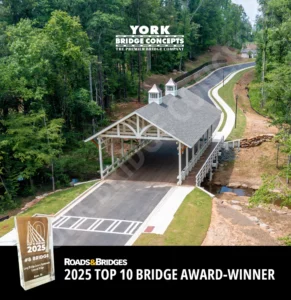

Custom Single-Lane Vehicular Bridges
Custom Single-Lane Vehicular Bridges
Single-lane bridges provide reliable vehicular access while accommodating the unique conditions of private roads, residential developments, parks, golf courses, resorts, campuses, and other properties. Whether crossing a creek, wetland, ravine, drainage area, or landscaped waterway, a properly designed single-lane bridge combines structural performance with the surrounding environment.
For more than 40 years, York Bridge Concepts has specialized in the design, engineering, and onsite construction of custom vehicular and pedestrian bridges. Our single-lane vehicular bridges are developed around each project's loading requirements, roadway geometry, span, foundations, materials, site conditions, and architectural objectives.
From functional access crossings to signature entrance bridges, YBC creates solutions that connect destinations while complementing the landscape.
What Is a Single-Lane Bridge?
A single-lane bridge is a vehicular crossing designed with one travel lane rather than two. These bridges are commonly considered for lower-volume roads, private properties, controlled-access routes, and locations where the anticipated traffic and applicable roadway requirements support a single-lane configuration.
Although narrower than a typical two-lane bridge, a single-lane bridge can be engineered for substantial vehicle loading. Depending on the project, the structure may need to accommodate passenger vehicles, delivery trucks, maintenance equipment, agricultural machinery, or emergency vehicles.
Single-lane bridge design involves more than determining the width of the deck. Engineers and project stakeholders must also consider vehicle movements, sight distance, traffic controls, approach geometry, structural loading, barriers, and the relationship between the bridge and surrounding roadway.
Where Are Single-Lane Bridges Used?
Single-lane vehicular bridges are suitable for a variety of applications where site conditions, traffic patterns, and design requirements support a one-lane crossing.
Private Driveways & Estates
A single-lane driveway bridge can provide access to residential estates, private properties, and rural homes separated by creeks, drainage channels, ponds, or other natural obstacles.
Custom bridge design allows the crossing to complement the property's architecture, landscape, and intended vehicle use.
Residential Communities & Developments
Single-lane bridges can serve private community roads, controlled-access routes, neighborhood amenities, and selected internal circulation connections.
For residential developments, architectural railings, materials, and finishes can help integrate the bridge with the community's identity while meeting functional requirements.
Parks & Recreation Areas
Parks may require bridges for maintenance vehicles, service equipment, emergency access, or limited vehicular circulation.
These crossings should be designed around the anticipated vehicle types, surrounding trails, landscape conditions, and applicable access requirements.
Golf Courses & Resorts
Golf courses and resorts often incorporate bridges into carefully designed landscapes.
Single-lane crossings can connect maintenance roads, service routes, guest facilities, and other destinations while preserving the character of the property.
Agricultural & Rural Properties
Rural bridges may provide access for farm equipment, service trucks, and other specialized vehicles.
Because agricultural and maintenance equipment can have different dimensions and loading requirements from passenger vehicles, these factors should be identified early in bridge planning.
Single-Lane Bridge Design Considerations
Every single-lane bridge begins with understanding the purpose of the crossing and the conditions surrounding it.
Single-Lane Bridge Width
The appropriate width of a single-lane bridge depends on the vehicles it must accommodate, traffic operations, roadway classification, barriers, approach geometry, and applicable design standards.
A bridge intended for passenger vehicles may have different requirements from one accommodating delivery trucks, fire apparatus, or agricultural equipment.
Clear roadway width should be coordinated with vehicle dimensions, lateral clearance, bridge railings, and the approach roadway.
Vehicular Bridge Loading
Single-lane does not necessarily mean light-duty.
Even when a bridge accommodates only one lane of traffic, its structure may need to support heavy vehicles such as delivery trucks, maintenance equipment, or emergency apparatus.
Depending on the project, vehicular bridge design may incorporate applicable highway loading criteria, including HS20-44 or HL-93 loading where required.
Structural requirements influence the bridge's framing, decking, connections, foundations, and overall configuration.
Bridge Length & Span Configuration
Single-lane vehicular bridges can incorporate different span configurations depending on the distance being crossed and the conditions beneath the structure.
A free-span bridge may be appropriate where intermediate supports are undesirable or impractical. Repetitive-span and multiple-span configurations may offer flexibility for longer crossings where foundations can be placed at suitable locations.
Span selection should account for structural loading, foundations, hydrology, environmental conditions, constructability, and project budget.
Foundations & Site Conditions
Foundations transfer the loads from a single-lane bridge into the supporting ground.
Foundation selection depends on soil conditions, structural loading, topography, water levels, scour potential, environmental requirements, and available construction access.
For bridges crossing wetlands, waterways, or difficult terrain, foundation placement may be a significant factor in the overall design.
Bridge Materials & Architectural Design
Material selection influences a single-lane bridge's structural performance, appearance, maintenance requirements, and lifecycle value.
Depending on the application, bridges may incorporate structural timber, engineered wood, steel, concrete, composites, or hybrid systems.
Custom architectural elements such as railings, finishes, trim, and decking can help the crossing complement surrounding development and landscape architecture.
Single-Lane vs. Double-Lane Bridges
Choosing between a single-lane and double-lane bridge requires evaluating how the crossing will function throughout its service life.
A single-lane bridge may be appropriate for a low-volume private road or controlled-access route where opposing traffic can be managed safely. A double-lane bridge may be more appropriate where traffic volume, roadway classification, operational requirements, or future development calls for simultaneous two-way vehicle movement.
Key considerations include traffic volume, anticipated vehicle types, roadway geometry, emergency access, sight distance, approach conditions, applicable design standards, and future use.
Although a narrower single-lane bridge may reduce certain material quantities, the overall project cost also depends on span, foundations, loading, site access, and construction requirements.
The best solution is the bridge configuration that meets the project's operational, structural, safety, and long-term needs.
Single-Lane Bridges With Pedestrian Walkways
Some projects require a crossing that accommodates both vehicles and pedestrians.
A single-lane vehicular bridge can incorporate an attached pedestrian walkway when the design provides appropriate space, separation, barriers, structural capacity, and connections to surrounding routes.
These combined crossings may be useful for campuses, communities, parks, resorts, and other locations where pedestrians and vehicles need to cross the same obstacle.
Pedestrian circulation and accessibility should be considered during early design rather than added after the vehicular bridge configuration has been established.
Single-Lane Bridges Over Creeks, Streams & Wetlands
Waterways and environmentally sensitive areas introduce additional considerations into single-lane bridge design and construction.
Projects may require coordination of bridge elevation, water flow, flood conditions, scour, foundations, span configuration, environmental requirements, and construction access.
Where conventional equipment access is difficult, the construction methodology can become an important part of the design strategy.
On suitable projects, YBC's proprietary Deck-Level Construction™ approach allows crews, materials, and equipment to advance from completed portions of the bridge, reducing reliance on continuous ground access beneath the structure.
This method can be particularly valuable where minimizing disturbance to surrounding terrain is a project priority.
How Are Single-Lane Bridges Constructed?
Single-lane bridge construction involves coordinating engineering, materials, foundations, structural components, site conditions, and field operations.
YBC's onsite construction approach allows bridge design and constructability to be considered together throughout project development.
A typical project may include initial planning and site evaluation, conceptual design, engineering coordination, foundation construction, structural framing, decking, railings or barriers, approaches, and final project review.
The specific sequence depends on the bridge configuration, site conditions, permitting, access, and construction requirements.
How Much Does a Single-Lane Bridge Cost?
The cost of a single-lane bridge varies depending on the requirements of the crossing.
Important cost factors include bridge length, clear roadway width, structural loading, span configuration, materials, foundations, site conditions, environmental requirements, architectural features, construction access, and approaches.
A shorter single-lane bridge with straightforward foundations and accessible construction conditions may have a different cost profile from a long free-span bridge over a waterway or wetland.
Because these variables interact, a project-specific evaluation is more meaningful than applying a universal cost per linear foot.
Early coordination with YBC can help identify the primary cost drivers and establish an appropriate direction for project budgeting.
The Avenue Collection: Custom Vehicular Bridges
YBC's Avenue Collection brings together custom vehicular bridge solutions designed around structural requirements, architecture, and the surrounding environment.
Single-lane bridges can incorporate traditional or contemporary styling, distinctive railings, custom finishes, and other project-specific features.
Whether the objective is to create a functional private road crossing or an architectural entrance feature, YBC develops bridges that balance performance, aesthetics, and constructability.
Why Choose York Bridge Concepts for Single-Lane Bridges?
With more than 40 years of experience and over 9,000 bridges constructed, York Bridge Concepts brings specialized bridge knowledge to projects across a wide range of applications and environments.
Our approach integrates bridge design, engineering coordination, material selection, onsite construction, and site-specific requirements.
YBC works with owners, architects, landscape architects, engineers, developers, municipalities, and contractors to develop bridge solutions that respond to the unique needs of each project.
From private driveway bridges to vehicular crossings within major developments, our team understands that a bridge must do more than connect two points. It must function reliably, integrate with its surroundings, and support the project's long-term objectives.