

The Industry Leader Since 1985
Onsite Bridge Construction
Precision In Onsite Construction
At York Bridge Concepts, we take pride in our expertise in onsite construction for timber bridges, bringing together innovation, safety, and environmental responsibility. Explore the comprehensive sections that define our seamless process.
Top-down bridge construction is an innovative and efficient method that has transformed the way bridges are built. This approach, widely used for both vehicular and pedestrian bridge projects, is renowned for its minimal environmental impact, rapid construction times, and ability to work in confined or sensitive spaces. Unlike traditional bottom-up methods, which require extensive excavation before construction begins, the top-down method starts at the top of the bridge, working down to the foundation.
The technique is particularly advantageous when dealing with sites that have limited space, sensitive ecosystems, or challenging environmental conditions. By starting the construction from above the ground, this method allows for continued use of the area below the structure, enabling traffic flow and access to nearby locations during construction. Moreover, top-down construction minimizes ground disruption, which is crucial in preserving surrounding ecosystems and maintaining the stability of nearby structures.
Key Benefits Include
Reduced environmental impact
Top-down construction reduces the need for a large-scale excavation, limiting soil disturbance and reducing the project's footprint.
Faster completion times
The method allows for simultaneous construction above and below ground, speeding up the overall timeline.
Enhanced Safety
The construction process is safer for workers, as much of the work takes places in a controlled environment, away from public areas.
As a method that balances speed, efficiency, and environmental responsibility, top-down construction is an ideal choice for many bridge projects.
Environmental & Safety Protocols
Our commitment to sustainability extends to every project. York Bridge Concepts adheres to stringent environmental and safety protocols, ensuring minimal impact on the surroundings and prioritizing the well-being of our team and your community.
Construction Methods
Building Approaches & Strategies Per Site Conditions
Site Preparation
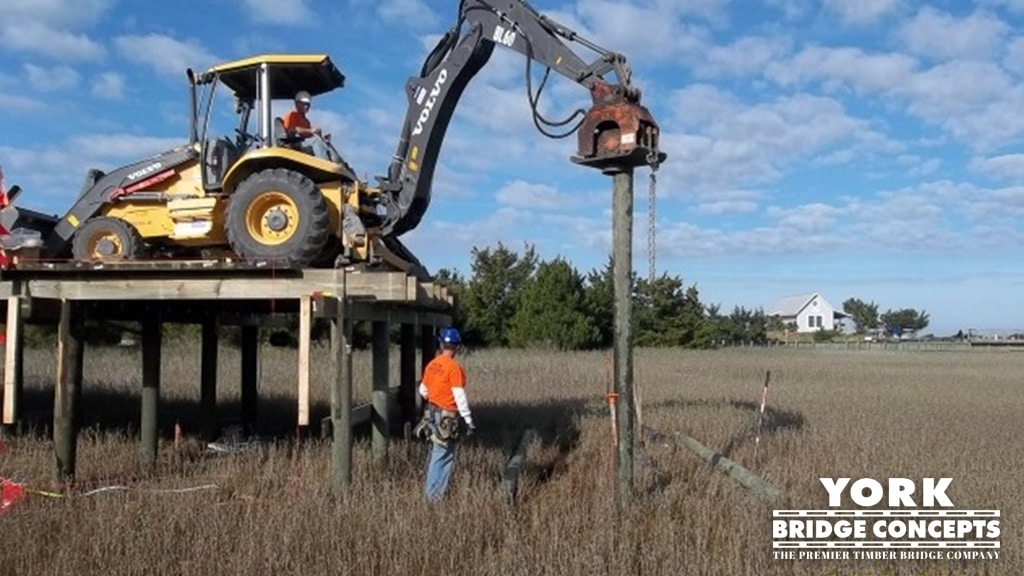
The first step in top-down construction is site preparation, which includes surveying the area to ensure it can support the structure. The site is then cleared of any obstacles or debris, and temporary safety measures are put in place. In many cases, environmental considerations will require a thorough assessment to minimize the impact on surrounding ecosystems.Foundation Work
Once the site is prepared, the next stage is foundation work. The process begins by drilling or driving piles into the ground to anchor the bridge's structure. These piles from the base that will support the entire bridge. In addition to piles, diaphragm walls are constructed to define the perimeter of the bridge, ensuring it remains stable during construction. This phase is crucial for ensuring the long-term durability and safety of the structure.Deck Construction
Once the site is prepared, the next stage is foundation work. The process begins by drilling or driving piles into the ground to anchor the bridge's structure. These piles from the base that will support the entire bridge. In addition to piles, diaphragm walls are constructed to define the perimeter of the bridge, ensuring it remains stable during construction. This phase is crucial for ensuring the long-term durability and safety of the structure.Final Touches
The final stage of the top-down construction process includes the installation of finishing elements such as guardrails, surface treatments, and landscaping. The bridge's exterior is treated with coatings and finishes that protect it from the elements, ensuring it remains durable and attractive for years to come.
1
Setting Foundations For Timber Bridges
A strong foundation is crucial for the longevity of any structure. York Bridge Concepts excels in setting foundations for timber bridges, employing engineering precision to ensure stability and resilience in diverse environmental conditions.
2
Constructing Abutments & Piling Bents
3
Framing Spans For Specific Crossings
Experience the artistry of timber bridge construction in our framing spans section. From the beauty of Glue Laminated Beams (Glulams) to the versatility of multiple spans, free spans, and repetitive spans, we tailor each project to your unique requirements.
4
Laying Vehicular Sub-Decking
5
Building & Raising Vehicular Guide Rails
Safety takes the forefront as we meticulously raise and build vehicular guide rails. Our experienced team ensures that each element aligns seamlessly, offering not only functionality but also aesthetic appeal to your timber bridge meeting all ASHTO requirements.
6
Laying Pedestrian Decking
7
Assembling, Aligning, & Fastening Pedestrian Guiderail Systems
8
Punchlist, Clean Up, Walkthrough, And Signoff
Environmental & Community Impact
One of the greatest advantages of top-down bridge construction is its positive impact on the environment and local communities. Here's hoe the benefits both:
Deck-Level
Construction
Minimal Environmental Disruption
Top-down construction minimizes the environmental impact of a protecting wildlife habitats and preventing soil erosion. The controlled excavation process also reduces the risk of contamination to nearby water bodies, making it an environmentally friendly construction method.
Preservation of Local Ecosystems
In many cases, top-down construction has been used to preserve ecosystems that would otherwise be disturbed by traditional construction methods. For example, when building in areas with wetlands or protected wildlife corridors, the top-down method allows for construction to proceed without significant alteration to the landscape. This approach is particularly beneficial in areas with sensitive ecological features, where construction could cause long-term environmental damage.
Enhanced Community Relations
By minimizing construction-related disruptions, top-down bridge construction helps maintain positive relationships with local communities. The method allows for continuous access to roads, parks, and other facilities that might otherwise be closed during traditional bridge construction. This continuity of access ensures that local businesses and residents are not significantly impacted, fostering goodwill between the construction team and the community.
Technological Innovations & Future Trends
At York Bridge Concepts, we are constantly advancing our top-down construction techniques to meet evolving challenges:
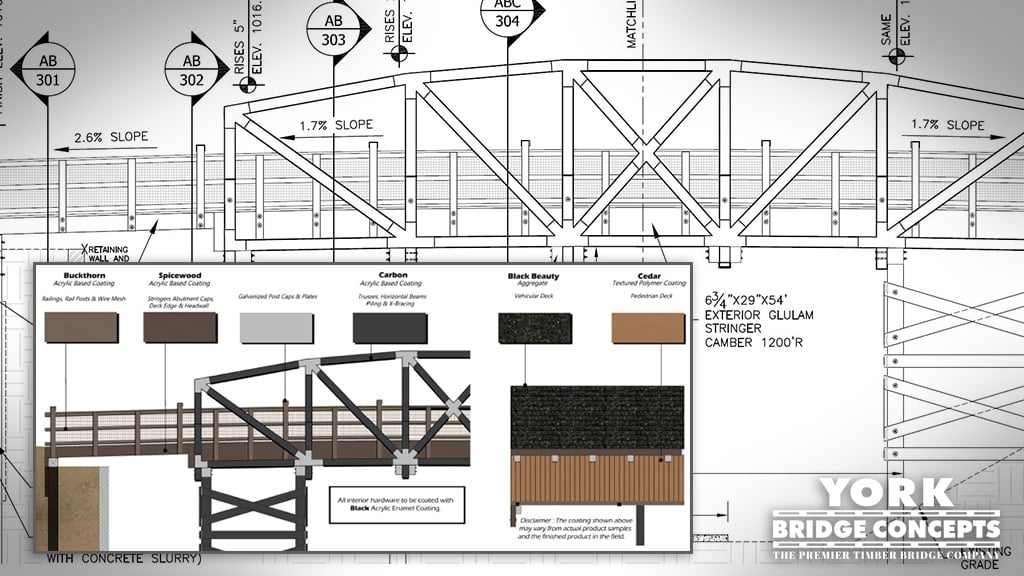
Coated Timber & Composite Components
High-quality, pre-coated timber elements and color-matched composite elements allow for a rapid on-site assembly and consistent quality control.
Sustainable Material Innovations
We continue to expand our use of renewable hardwoods, advanced polymer coatings, recyclable concrete, composite materials, and metal components.
Digital Design & Engineering
Modeling technologies enable us to simulate complex site conditions and streamline construction sequencing.
Community-Driven Design
We actively incorporate stakeholder feedback and environmental data to ensure each bridge aligns with community values and ecological stewardship.
York Bridge Concepts remains at the forefront of timber bridge innovation, delivering projects that balance beauty, function, and environmental responsibility.
An Invitation to Partner with York Bridge Concepts
York Bridge Concepts' expertise in on-site top-down timber bridge construction sets us apart as leaders in sustainable infrastructure. Our proven process, combined with innovative design and a deep commitment to environmental stewardship, delivers bridges that stand the test of time while respecting the world around them.
Whether your project involves wetlands, protected habitats, or sensitive community settings, our team is ready to partner with you to create a timber bridge solution that fits your vision and requirements.
Contact York Bridge Concepts today to learn more about how our top-down construction expertise can bring your next bridge project to life--beautifully, efficiently, and responsibly.