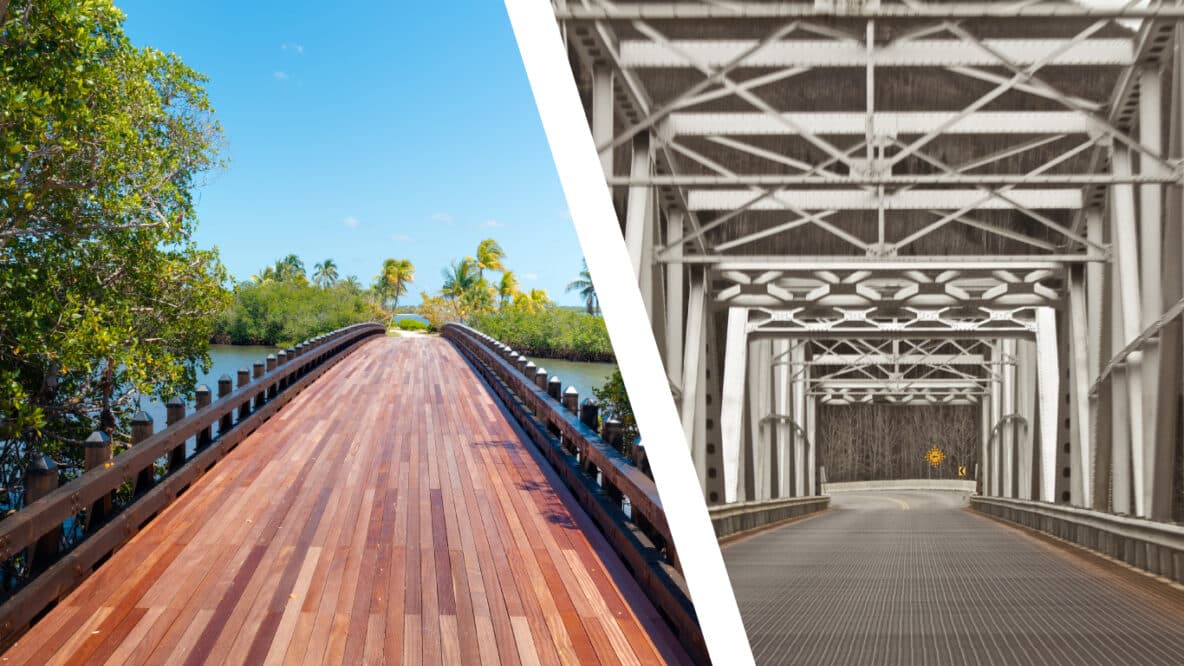
Choosing Timber or Steel
Selecting the right bridge material is one of the most important decisions in any infrastructure project. While both timber and steel bridges offer distinct advantages, the best choice depends on your project’s goals, environmental conditions, architectural vision, budget, and long-term maintenance expectations.
At York Bridge Concepts (YBC), we specialize exclusively in custom timber bridges because we believe modern timber construction offers an exceptional balance of engineering performance, sustainability, durability, and architectural beauty. However, every project is unique, and understanding the strengths of both materials helps owners, architects, engineers, and developers make informed decisions. YBC notes that the decision between timber and steel depends on project requirements, aesthetics, sustainability goals, and budget—not a one-size-fits-all answer.
Timber vs. Steel: Understanding the Difference
Both timber and steel have proven track records in bridge construction. Steel has traditionally been selected for very long-span infrastructure and heavy highway applications, while engineered timber has become an increasingly popular solution for pedestrian bridges, vehicular bridges, boardwalks, golf cart bridges, parks, resorts, campuses, municipalities, and master-planned communities.
The right material depends on factors such as:
- Required load capacity
- Bridge span length
- Site conditions
- Environmental sensitivity
- Architectural objectives
- Construction timeline
- Long-term maintenance
- Project budget
Rather than asking which material is “better,” the more important question is which material best supports the long-term goals of your project.
Sustainability: Timber Leads the Way
One of timber’s greatest advantages is its environmental performance.
Responsibly sourced timber is a renewable building material that naturally stores carbon throughout its service life. Compared to steel production, timber generally requires significantly less energy to manufacture and transport, resulting in a substantially lower carbon footprint. Timber also continues to store carbon over time, while steel production is energy-intensive and produces significantly higher greenhouse gas emissions.
Additional environmental benefits include:
- Renewable resource
- Lower embodied carbon
- Carbon sequestration
- Reduced manufacturing emissions
- Responsible forestry practices
- Natural integration with surrounding landscapes
For environmentally sensitive projects, timber often aligns more closely with sustainability goals and green infrastructure initiatives.
Environmental Impact During Construction
The bridge material itself is only part of the environmental equation. Construction methods also play a major role.
York Bridge Concepts’ proprietary Deck-Level (Top-Down) Construction methodology allows crews to build bridges from the bridge deck itself, significantly reducing disturbance to:
- Wetlands
- Streams
- Lakes
- Rivers
- Native vegetation
- Wildlife habitats
- Protected ecosystems
This approach minimizes equipment access below the bridge, making timber an excellent solution for environmentally sensitive sites. YBC highlights Deck-Level construction as a key differentiator for reducing environmental disruption compared to conventional bridge construction methods.
Durability and Longevity
Modern engineered timber bridges differ dramatically from the untreated wood bridges of decades past.
Today’s timber bridges incorporate:
- Pressure-treated structural timber
- Engineered glulam members
- Advanced preservative systems
- Premium protective coatings
- Stainless or galvanized hardware
- Proven structural engineering
When properly designed and maintained, timber bridges can provide 75 years or more of service life while resisting decay, moisture, and insect damage. YBC states its properly maintained timber bridges are designed for a 75+ year lifespan and naturally avoid corrosion issues associated with steel.
Steel bridges are exceptionally strong but often require ongoing protection against corrosion, particularly in coastal environments, humid climates, or locations exposed to deicing salts.
Maintenance Considerations
Long-term ownership costs often extend well beyond initial construction.
Timber bridge maintenance typically focuses on:
- Routine inspections
- Protective coating renewal
- Occasional component replacement
- Preventative maintenance
Steel bridges frequently require:
- Corrosion monitoring
- Surface preparation
- Repainting
- Protective coating maintenance
- Rust remediation
The maintenance requirements of either material vary depending on environmental exposure, but corrosion protection is often one of the largest long-term considerations for steel structures.
Architectural Flexibility
For projects where appearance matters, timber offers a distinctive advantage.
Natural wood creates warmth, character, and visual appeal that complements:
- Parks
- Nature preserves
- Residential communities
- Resorts
- Golf courses
- Universities
- Historic districts
- Waterfront developments
- Municipal parks
- Public gathering spaces
York Bridge Concepts customizes every bridge with architectural options including:
- Heavy timber construction
- Decorative rail systems
- Wire mesh railings
- Cable rail systems
- Covered bridge designs
- Scenic overlooks
- Decorative post caps
- Integrated lighting
- Premium decking materials
Rather than appearing as purely functional infrastructure, timber bridges often become iconic community landmarks.
Construction Efficiency
Every bridge project presents unique construction challenges.
Timber bridges can often provide advantages through:
- Reduced material weight
- On-site customization
- Faster installation
- Lower equipment requirements
- Reduced environmental disturbance
York Bridge Concepts builds bridges on-site, allowing each structure to be precisely adapted to existing site conditions while minimizing transportation and lifting challenges associated with large prefabricated bridge components.
Cost Considerations
Initial construction cost is only one part of evaluating a bridge investment.
Owners should also consider:
- Lifecycle maintenance
- Inspection costs
- Environmental permitting
- Construction duration
- Equipment access
- Future rehabilitation
- Service life
- User experience
Depending on project requirements, timber can often provide a highly competitive total cost of ownership, particularly for pedestrian bridges, parks, residential developments, golf courses, and municipal infrastructure. Independent bridge engineering research has long recognized that different bridge materials are economically competitive under different span lengths, site conditions, and project objectives.
When Timber Is an Excellent Choice
Timber bridges are particularly well suited for:
- Municipal parks
- Greenway trails
- Nature preserves
- Wetland crossings
- Universities
- Resorts
- Golf courses
- Residential developments
- Mixed-use communities
- Campuses
- Boardwalks
- Waterfront destinations
These projects benefit from timber’s architectural beauty, sustainability, and ability to integrate naturally into surrounding landscapes.
A Bridge Designed Around Your Project
At York Bridge Concepts, we don’t believe every project should automatically use timber or steel. Instead, we believe every bridge should be evaluated according to its unique requirements.
Our experienced design-build team works with owners, architects, engineers, and developers to determine the most appropriate solution based on:
- Engineering requirements
- Environmental conditions
- Budget objectives
- Architectural vision
- Long-term ownership goals
When a custom timber bridge is the right fit, our team delivers infrastructure that combines engineering excellence, sustainability, and timeless craftsmanship.
- All
- Alabama
- Architectural-Design
- Arizona
- Avenue Collection
- Boardwalks
- Bridge Education
- Bridge Types
- California
- Case Study
- Classic
- Colorado
- Commercial Bridges
- Community Designed Projects
- Connecticut
- Construction Techniques for Wood Bridges
- Contemporary Series
- Covered Bridges
- Culvert vs Bridge
- Delaware
- Eco-Tourism Bridges
- Environmental Benefits of Wooden Bridges
- Environmental Mitigation
- Extreme Grades
- Featured
- Floodplain
- Florida
- Free Span Bridge
- Georgia
- Golf Cart Bridge Designs
- Golf Cart Bridges
- Idaho
- Illinois
- International
- Lakes
- Locations
- Louisiana
- Maine
- Maryland
- Massachusetts
- Master Planned Community
- Michigan
- Missouri
- Mixed-Use Development
- Montana
- Multiple Crossings
- Multiple Span
- New Hampshire
- New Jersey
- New York
- North Carolina
- Ohio
- Oklahoma
- Overpasses
- Pedestrian Bridge Designs
- Pedestrian Bridges
- Pennsylvania
- Popular Articles
- Prefabricated Bridges For Sale
- Private Collection
- Repetitive Span
- Retail Developments
- Short Span Timber Bridges
- South Carolina
- Span Types
- Streams
- Tennessee
- Texas
- The LiNK
- Timber Bridge Designs
- Timber vs Steel
- Types of Wood Bridges
- Uncategorized
- Vehicular Bridge Designs
- Vehicular Bridges
- Virginia
- Waterside Collection
- West Virginia
- Wetland Conservation Conservation Bridges