June 19, 2018

View images & specs of this project.


Not every bridge project begins on level ground.
Some of the most rewarding and technically demanding bridge projects involve steep hillsides, mountainous terrain, dramatic elevation changes, deep ravines, rugged landscapes, and environmentally sensitive areas where traditional construction methods simply aren’t practical.
These sites require more than a standard bridge design. They require creative engineering, specialized construction methodologies, and a deep understanding of how infrastructure can work with challenging topography rather than against it.
At York Bridge Concepts, we specialize in designing and constructing custom timber bridges that thrive in difficult environments. Through our Design-Engineer-Build™ methodology and proprietary Deck-Level Construction™ process, we help developers, municipalities, parks departments, resorts, golf courses, trail systems, and private property owners overcome extreme grade challenges while preserving the natural beauty of the landscape. YBC’s project portfolio includes trail bridges, pedestrian bridges, vehicular crossings, and boardwalk systems designed for challenging terrain and environmentally sensitive locations.
An extreme grade bridge is a bridge designed to accommodate significant changes in elevation between one side of the crossing and the other.
These projects often involve:
Unlike conventional crossings on relatively flat terrain, extreme grade bridges must account for elevation transitions, drainage patterns, soil conditions, user accessibility, and unique structural loading considerations. Engineers frequently evaluate topography, access constraints, and load requirements when designing bridges for difficult terrain.
Steep terrain introduces challenges that extend far beyond bridge span length.
Project teams must carefully evaluate:
Significant differences between approach grades can influence bridge geometry, user experience, drainage, and structural design.
Steep terrain often limits equipment access and staging areas during construction.
Many steep terrain sites are located within forests, wetlands, mountainsides, conservation lands, or environmentally protected areas.
Bridge approaches and surrounding landscapes must be designed to manage runoff and minimize erosion risks.
Structures must withstand environmental conditions such as heavy rainfall, slope movement, freeze-thaw cycles, and changing hydrological conditions.
These factors require an integrated approach that combines engineering expertise with practical construction experience.
Timber has become an increasingly popular material for extreme grade bridge applications because of its flexibility, sustainability, and ability to adapt to unique site conditions.
Benefits include:
Because every bridge is custom designed, timber structures can be adapted to fit challenging topography without requiring extensive site modification.
This allows projects to preserve more of the natural landscape while achieving functional access goals.
At York Bridge Concepts, every extreme grade project begins with understanding the site.
Our design process evaluates:
The goal is not to force a standard bridge solution onto a difficult site.
The goal is to create a bridge specifically designed for the terrain it serves.
Through the Decero™ Design Studio process, our team develops site-specific concepts that respond directly to the landscape.
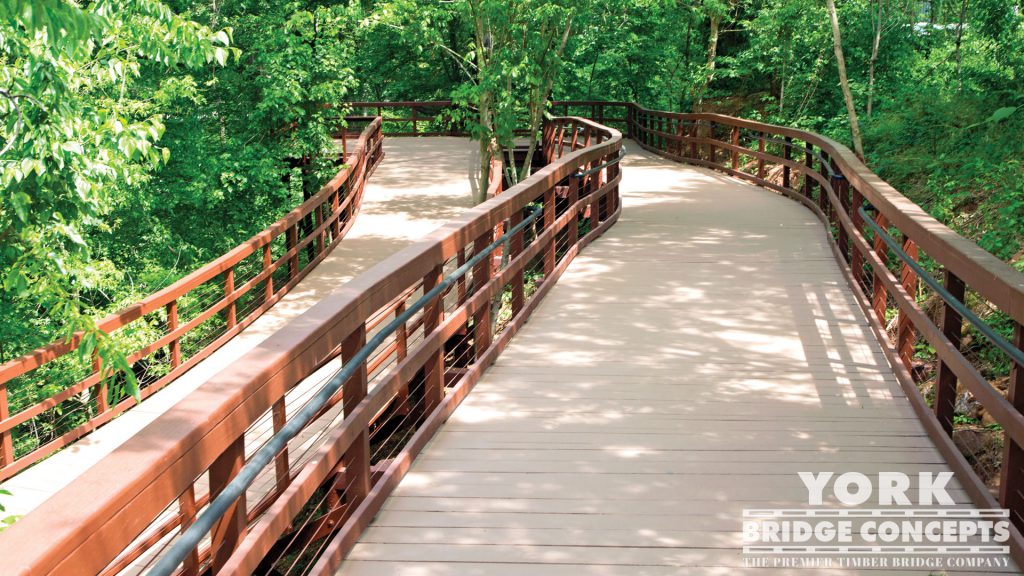
Many extreme grade projects involve trail systems located within mountainous or heavily wooded environments.
Trail bridges frequently help users navigate:
Rather than requiring extensive grading or switchback systems, strategically placed bridges can provide safer and more efficient routes while preserving the natural character of the landscape.
The Quest Collection of trail bridges was developed specifically to enhance access within challenging outdoor environments.
Pedestrian bridges often play a vital role in improving accessibility across difficult landscapes.
Applications include:
Well-designed pedestrian bridges can help users safely navigate elevation changes while providing scenic viewpoints and memorable experiences.
Many of the most iconic pedestrian bridges are located in environments where terrain itself becomes part of the experience.
Steep terrain can present significant challenges for vehicular access.
Whether serving residential communities, mountain developments, resort properties, or private estates, vehicular bridges often must accommodate:
York Bridge Concepts develops custom vehicular bridge solutions engineered to support required load capacities while integrating seamlessly into complex topography. YBC’s Avenue Collection is engineered for applications ranging from residential access bridges to community infrastructure designed for demanding terrain conditions.
One of the greatest challenges associated with steep terrain projects is construction access.
Traditional bridge construction methods often require extensive ground access, temporary roads, and heavy equipment operating within sensitive environments.
York Bridge Concepts’ proprietary Deck-Level Construction™ methodology helps solve this challenge.
Construction progresses from the bridge deck itself, allowing crews to work from above rather than requiring extensive disturbance below the structure.
Benefits include:
This approach is especially valuable in mountainous environments, forested areas, wetlands, and conservation lands. Top-down construction methodologies are widely recognized for reducing impacts in environmentally sensitive and difficult-to-access locations.
Steep terrain often overlaps with environmentally sensitive landscapes.
Projects may involve:
Timber bridges help minimize environmental impacts through:
YBC’s timber bridge systems contribute to broader sustainability goals while creating infrastructure that complements the natural environment. YBC reports more than 48,000 tons of carbon savings through its timber bridge portfolio and emphasizes sustainable construction practices across all collections.
Providing access while preserving natural topography.
Creating trail connections across rugged terrain.
Improving access to scenic and remote environments.
Connecting amenities across steep landscapes.
Providing infrastructure within challenging terrain conditions.
Balancing access and environmental stewardship.
Connecting facilities across uneven landscapes.
For more than 40 years, York Bridge Concepts has helped clients solve complex site challenges through innovative bridge design and construction.
Clients choose YBC because of our:
Our bridges are designed to overcome obstacles while enhancing the places they serve.
The most successful bridge projects don’t fight the terrain.
They embrace it.
Extreme grade bridges allow communities, developers, engineers, and landowners to create access where others see limitations. They transform steep slopes into opportunities, connect destinations across challenging landscapes, and preserve the natural character that makes a place special.
Whether your project involves a mountain trail, a steep residential development, a resort destination, a park system, or an environmentally sensitive landscape, York Bridge Concepts can create a custom bridge solution designed specifically for the terrain beneath it.
This website uses cookies
We use cookies to personalise content and ads, to provide social media features and to analyse our traffic. We also share information about your use of our site with our social media, advertising and analytics partners who may combine it with other information that you’ve provided to them or that they’ve collected from your use of their services.
Cookies are small text files that can be used by websites to make a user's experience more efficient.
The law states that we can store cookies on your device if they are strictly necessary for the operation of this site. For all other types of cookies we need your permission. This means that cookies which are categorized as necessary, are processed based on GDPR Art. 6 (1) (f). All other cookies, meaning those from the categories preferences and marketing, are processed based on GDPR Art. 6 (1) (a) GDPR.
This site uses different types of cookies. Some cookies are placed by third party services that appear on our pages.
You can at any time change or withdraw your consent from the Cookie Declaration on our website.
Learn more about who we are, how you can contact us and how we process personal data in our Privacy Policy.
Please state your consent ID and date when you contact us regarding your consent.