HL-93 Timber Bridges
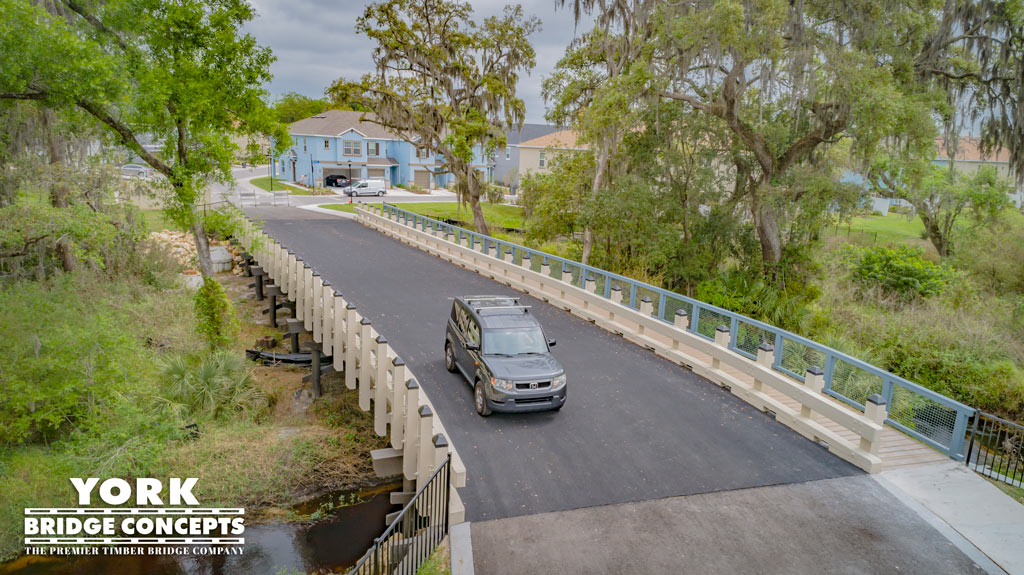
When bridge projects require today’s highway loading standards, HL-93 timber bridges provide the structural performance needed to safely accommodate modern vehicular traffic while delivering the architectural warmth and sustainability of timber construction. Designed in accordance with the AASHTO LRFD Bridge Design Specifications, HL-93 loading has become the standard design criterion for many new highway and roadway bridges throughout North America. It combines a design truck or design tandem with a design lane load to represent modern traffic demands and is the current benchmark for many transportation projects.
At York Bridge Concepts, every HL-93 timber bridge is custom engineered to meet the project’s specific loading requirements, site conditions, and architectural objectives. Whether serving municipalities, private developments, commercial properties, campuses, or transportation infrastructure, our bridges deliver long-term performance without sacrificing aesthetics or environmental responsibility.
What Is an HL-93 Bridge?
HL-93 is the live-load design standard established by the American Association of State Highway and Transportation Officials (AASHTO) for many new highway bridges designed using the LRFD methodology. Unlike older loading standards, HL-93 accounts for a combination of design truck, design tandem, and lane loading to better represent modern traffic conditions.
Bridges designed for HL-93 loading are commonly specified for:
- Public roadways
- Municipal infrastructure
- Commercial developments
- Industrial facilities
- Mixed-use developments
- University campuses
- Emergency access routes
- Private roads
- Transportation improvements
- Large residential communities
York Bridge Concepts designs custom timber bridges to satisfy HL-93 loading where required by the project engineer or governing authority.
Why Choose an HL-93 Timber Bridge?
Projects requiring highway-level structural capacity no longer have to sacrifice architectural character. Modern engineered timber bridges can provide the strength necessary for demanding vehicular applications while offering the natural beauty and sustainability that distinguish timber construction.
Benefits of HL-93 timber bridges include:
- Engineered for modern highway loading requirements
- Custom structural design for each project
- Long service life
- Attractive architectural appearance
- Sustainable timber construction
- Reduced environmental impact
- Flexible span configurations
- Lower life-cycle maintenance when properly maintained
Whether crossing streams, wetlands, roadways, or environmentally sensitive terrain, HL-93 timber bridges provide dependable performance for demanding transportation applications.
Applications for HL-93 Timber Bridges
York Bridge Concepts designs HL-93 bridges for a variety of public and private projects, including:
- Municipal roadways
- County roads
- Master-planned communities
- Commercial developments
- Industrial facilities
- Parks with maintenance vehicle access
- Resort developments
- University campuses
- Healthcare campuses
- Government infrastructure
- Corporate campuses
- Private developments requiring heavy vehicular access
Every bridge is custom engineered to meet site-specific conditions and applicable loading requirements.
Engineered Through the Decero™ Design Studio
Every York Bridge Concepts bridge begins with our proprietary Decero™ Design Studio, where engineers develop a custom solution based on the unique characteristics of the project.
Our design process evaluates:
- HL-93 loading requirements
- Span length
- Site topography
- Hydrology
- Soil conditions
- Environmental constraints
- Traffic volume
- Architectural preferences
- Long-term maintenance planning
Rather than adapting standardized bridge plans, every structure is engineered specifically for its intended application.
Sustainable Construction Without Compromising Performance
Heavy-duty bridge design and environmental stewardship can work together. York Bridge Concepts complements its structural engineering expertise with its proprietary Top-Down (Deck-Level) Construction™ methodology whenever practical.
This construction approach helps:
- Minimize disturbance to wetlands and waterways
- Reduce soil compaction
- Preserve native vegetation
- Limit erosion and sedimentation
- Improve construction efficiency on difficult sites
By combining advanced engineering with environmentally responsible construction practices, York Bridge Concepts creates infrastructure that supports both transportation needs and natural resource protection.
Premium Materials for Heavy-Duty Applications
HL-93 timber bridges utilize engineered structural systems selected for strength, durability, and long-term performance.
Available material options include:
- Southern Yellow Pine
- Douglas Fir glulam
- Premium hardwood decking
- Composite decking
- Protective timber coating systems
- Decorative railing systems
- Architectural lighting
- Custom stain finishes
Each bridge is engineered as a complete structural system designed to perform reliably under demanding traffic conditions.
Why Choose York Bridge Concepts?
For more than 40 years, York Bridge Concepts has specialized exclusively in custom timber bridge engineering and construction. With more than 9,000 bridges completed throughout North America, we have extensive experience designing structures for a wide range of load capacities, including pedestrian, light vehicular, H-Series, HS20-44, and HL-93 applications.
Our integrated Design-Engineer-Build™ process simplifies project delivery by combining custom engineering, in-house manufacturing, and on-site construction under one experienced team. Whether your project involves a municipal roadway, commercial development, private community, or transportation improvement, York Bridge Concepts delivers HL-93 timber bridges engineered for safety, sustainability, and decades of dependable service.
- All
- Alabama
- Architectural-Design
- Arizona
- Avenue Collection
- Boardwalks
- Bridge Education
- Bridge Types
- California
- Case Study
- Classic
- Colorado
- Commercial Bridges
- Community Designed Projects
- Connecticut
- Construction Techniques for Wood Bridges
- Contemporary Series
- Covered Bridges
- Culvert vs Bridge
- Delaware
- Eco-Tourism Bridges
- Environmental Benefits of Wooden Bridges
- Environmental Mitigation
- Extreme Grades
- Featured
- Floodplain
- Florida
- Free Span Bridge
- Georgia
- Golf Cart Bridge Designs
- Golf Cart Bridges
- Idaho
- Illinois
- International
- Lakes
- Locations
- Louisiana
- Maine
- Maryland
- Massachusetts
- Master Planned Community
- Michigan
- Missouri
- Mixed-Use Development
- Montana
- Multiple Crossings
- Multiple Span
- New Hampshire
- New Jersey
- New York
- North Carolina
- Ohio
- Oklahoma
- Overpasses
- Pedestrian Bridge Designs
- Pedestrian Bridges
- Pennsylvania
- Popular Articles
- Prefabricated Bridges For Sale
- Private Collection
- Repetitive Span
- Retail Developments
- Short Span Timber Bridges
- South Carolina
- Span Types
- Streams
- Tennessee
- Texas
- The LiNK
- Timber Bridge Designs
- Timber vs Steel
- Types of Wood Bridges
- Uncategorized
- Vehicular Bridge Designs
- Vehicular Bridges
- Virginia
- Waterside Collection
- West Virginia
- Wetland Conservation Conservation Bridges