HS27-44 Load Capacity Timber Bridges

Some bridge projects demand structural capacity beyond conventional vehicular traffic. Industrial developments, ports, utility facilities, heavy commercial properties, and specialized infrastructure often require bridges capable of supporting heavier vehicles while maintaining long-term structural reliability. An HS27-44 load capacity bridge is designed to accommodate these increased loading requirements through site-specific engineering, premium structural materials, and carefully designed bridge systems.

At York Bridge Concepts, every heavy-duty timber bridge is engineered through our proprietary Decero™ Design Studio and delivered using our integrated Design-Engineer-Build™ process. Rather than relying on standard bridge configurations, each bridge is custom designed around the project’s anticipated vehicle loading, environmental conditions, and long-term operational needs.

Since 1985, York Bridge Concepts has completed more than 9,000 custom timber bridges throughout North America, engineering structures for applications ranging from pedestrian crossings to bridges designed for demanding commercial and industrial loading requirements.


What Is an HS27-44 Load Capacity?

HS27-44 refers to a heavy vehicular bridge design loading based on the traditional AASHTO Standard Specifications for Highway Bridges. Within the HS-series, the numerical designation represents the design gross vehicle weight of the tractor portion of the design vehicle, while the “-44” suffix identifies the original AASHTO specification year in which the loading model was adopted. Higher HS classifications represent progressively greater loading demands than lower HS designations.

While many bridges today are designed using HL-93 criteria under current LRFD specifications, HS load classifications continue to be referenced for bridge evaluations, owner requirements, rehabilitation projects, and specialized engineering applications.


When Is HS27-44 Appropriate?

An HS27-44 design may be considered for projects expecting heavier-than-standard traffic or owner-specific loading requirements.

Typical applications include:

  • Industrial facilities
  • Manufacturing campuses
  • Utility infrastructure
  • Ports and marine terminals
  • Heavy commercial developments
  • Distribution centers
  • Mining operations
  • Resource management facilities
  • Municipal service roads
  • Specialized private developments

Every York Bridge Concepts bridge is engineered according to the specific loading criteria established for the project.


Designed Through the Decero™ Design Studio

Every heavy-duty bridge begins with the Decero™ Design Studio, where engineers and designers evaluate the project’s operational requirements before developing a custom bridge solution.

Our engineering process considers:

  • Design vehicle requirements
  • Gross vehicle weights
  • Axle spacing
  • Traffic frequency
  • Span configuration
  • Geotechnical conditions
  • Hydrology
  • Environmental exposure
  • Future operational needs
  • Long-term maintenance planning

This project-specific approach ensures that each bridge is engineered to safely support its intended use while optimizing structural efficiency.


Engineered Heavy-Duty Timber Bridge Systems

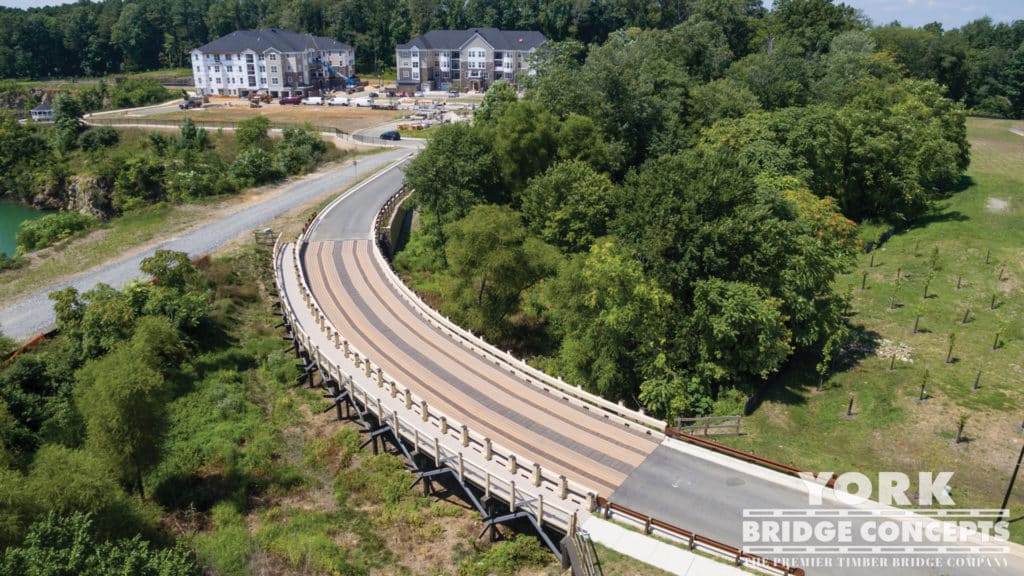
York Bridge Concepts designs heavy-duty timber bridges using engineered structural systems selected for each project’s loading demands.

Available bridge systems include:

  • Free-span bridges
  • Multiple long-span bridges
  • Repetitive-span bridges
  • Pile-supported bridges
  • Vehicular bridges
  • Community access bridges
  • Industrial access bridges
  • Maintenance access bridges

Structural configurations are selected based on span length, foundation conditions, hydraulic requirements, and design loading.


Premium Structural Materials

Heavy-duty timber bridges require materials engineered for strength, durability, and long-term performance.

Available material options include:

  • Douglas Fir glulam beams
  • Southern Yellow Pine structural framing
  • Premium hardwood wear decks
  • Composite decking
  • Stainless steel hardware
  • Protective coating systems
  • Decorative railing systems
  • Architectural lighting

Material selection is based on structural demands, environmental conditions, owner preferences, and lifecycle performance objectives.


Sustainable Construction for Heavy Infrastructure

Heavy-duty bridge projects often occur within environmentally sensitive locations where minimizing construction impacts remains important.

Whenever practical, York Bridge Concepts utilizes its proprietary Top-Down (Deck-Level) Construction™ methodology, allowing construction to progress from the completed bridge deck rather than requiring heavy equipment to operate throughout wetlands, waterways, or protected landscapes.

This construction approach helps:

  • Protect wetlands
  • Preserve native vegetation
  • Reduce soil compaction
  • Minimize erosion and sedimentation
  • Maintain natural drainage
  • Reduce construction impacts on sensitive ecosystems

Even for bridges designed for substantial vehicle loading, environmental stewardship remains a central part of the engineering process.


Applications Across Multiple Markets

HS27-44 timber bridges may be engineered for projects serving:

  • Industrial developments
  • Manufacturing facilities
  • Utility providers
  • Municipal infrastructure
  • Commercial developments
  • Resource management operations
  • Transportation corridors
  • Private developments
  • Maintenance access roads
  • Heavy equipment crossings

Every bridge is designed around the owner’s operational requirements rather than a standardized bridge model.


Custom Engineering for Project-Specific Loads

No two heavy-duty bridge projects are exactly alike.

York Bridge Concepts regularly engineers bridges to satisfy owner-specified loading criteria, including:

  • H-Series loading
  • HS-Series loading
  • HL-93 loading
  • Maintenance vehicle loading
  • Emergency vehicle access
  • Utility equipment access
  • Custom project-specific vehicle requirements

By evaluating anticipated traffic, operating conditions, and future use, our engineers develop structural systems tailored to each project’s needs.


Why Choose York Bridge Concepts?

For more than 40 years, York Bridge Concepts has specialized exclusively in custom timber bridge engineering and construction. Through our integrated Design-Engineer-Build™ process, we manage every phase of the project—from concept development and engineering through manufacturing and on-site construction.

With more than 9,000 custom bridges completed throughout North America, York Bridge Concepts has extensive experience engineering bridges for demanding loading requirements across municipalities, industrial facilities, commercial developments, residential communities, parks, and transportation infrastructure. Whether your project requires an HS27-44 bridge, HL-93 loading, or another project-specific design criterion, our team delivers custom timber bridge solutions engineered for safety, durability, and long-term performance.