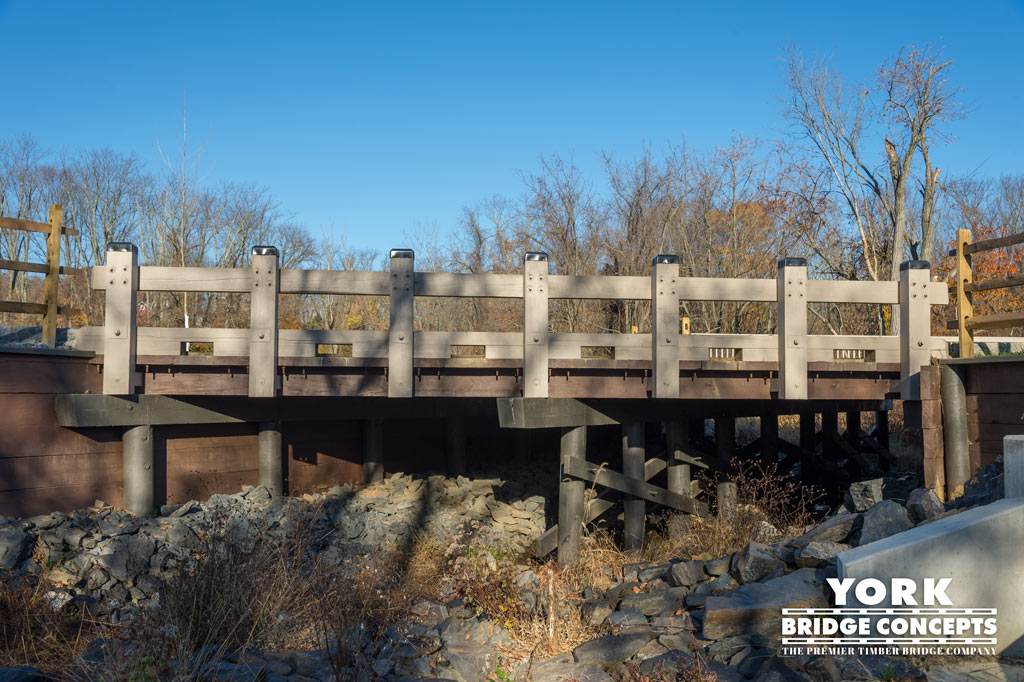
Skewed Bridge Design

Solving Complex Site Challenges Through Innovative Bridge Engineering

Not every bridge crossing occurs at a perfect 90-degree angle.

In fact, many of the most challenging and innovative bridge projects require designers and engineers to work with existing roadways, trails, waterways, rail corridors, wetlands, and site constraints that create non-perpendicular crossings. When a bridge crosses an obstacle at an angle rather than straight across, it is commonly referred to as a skewed bridge. These structures require specialized engineering and thoughtful design to safely accommodate unique load paths, support conditions, and site requirements.

At York Bridge Concepts, skewed bridge design is an opportunity—not a limitation.

Through our Design-Engineer-Build™ methodology, we develop custom timber bridge solutions that adapt to the realities of the site while maintaining structural performance, architectural beauty, and environmental stewardship. Whether crossing wetlands, streams, roadways, floodplains, golf courses, or community trail systems, our team designs bridges that work with the landscape rather than forcing the landscape to conform to the bridge.

What Is a Skewed Bridge?

A skewed bridge is a bridge whose supports are positioned at an angle relative to the bridge alignment.

Rather than crossing directly perpendicular to the obstacle below, the bridge crosses at a skewed angle due to existing roadway alignments, environmental constraints, property boundaries, utility conflicts, or other site-specific conditions. This geometry creates unique engineering considerations because loads do not transfer through the structure in the same way they do on a traditional square bridge. Torsional effects and more complex load distribution patterns often need to be addressed during design.

Common examples include:

  • Roadways crossing streams at an angle
  • Trails crossing wetlands diagonally
  • Bridges connecting offset destinations
  • Community entrances following curved roadway alignments
  • Golf cart crossings following course routing
  • Bridges spanning irregular waterways

Why Skewed Designs Are Often Necessary

Site conditions rarely cooperate with ideal bridge geometry.

Developers, engineers, and planners frequently encounter situations where a straight crossing would create unnecessary environmental impacts, increase project costs, or disrupt existing infrastructure.

A skewed bridge can help:

  • Preserve natural features
  • Minimize environmental disturbance
  • Maintain roadway alignments
  • Reduce grading requirements
  • Improve traffic circulation
  • Preserve existing trail routes
  • Accommodate property boundaries
  • Avoid utility conflicts

Rather than forcing significant site modifications, a skewed bridge allows infrastructure to adapt to the landscape.

Engineering Challenges of Skewed Bridges

Although skewed bridges offer many advantages, they require specialized engineering expertise.

When a bridge is skewed, forces do not move through the structure in the same manner as a conventional perpendicular crossing. Engineers must account for:

Torsional Forces

Skewed support arrangements can introduce torsional effects that must be carefully analyzed during design.

Uneven Load Distribution

Traffic and pedestrian loads may distribute differently across the bridge deck and supporting members compared to traditional bridge configurations.

Complex Support Conditions

Bearings, abutments, and foundations often require customized detailing to accommodate the geometry of the crossing.

Unique Construction Sequencing

Construction activities may require specialized planning to ensure efficient installation while maintaining safety and minimizing environmental impacts.

At York Bridge Concepts, our engineering team evaluates these factors early in the design process to develop solutions tailored to the specific conditions of each site.

Benefits of Skewed Bridge Design

While skewed bridges may present engineering complexities, they often deliver significant project benefits.

Better Site Integration

A skewed bridge can follow the natural alignment of roads, trails, and pathways, creating a more intuitive user experience.

Reduced Environmental Impacts

Aligning the bridge with existing site conditions often minimizes disturbance to wetlands, waterways, vegetation, and wildlife habitat.

Improved Project Efficiency

In many cases, a skewed crossing can reduce earthwork, retaining walls, roadway modifications, and utility relocations.

Enhanced User Experience

A bridge that follows the natural flow of movement often feels more comfortable and inviting to users.

Skewed Pedestrian Bridges

Pedestrian bridge projects frequently benefit from skewed designs.

Trail systems, parks, campuses, and community pathways rarely follow perfectly straight alignments. A skewed bridge can preserve the natural flow of the route while reducing impacts on the surrounding environment.

Applications include:

  • Nature trails
  • Greenways
  • University campuses
  • Community parks
  • Waterfront pathways
  • Boardwalk systems
  • Eco-tourism destinations

By aligning with the existing trail network, skewed pedestrian bridges create more natural and enjoyable experiences for users.

Skewed Vehicular Bridges

Vehicular bridge projects often encounter skewed crossing conditions when roads intersect streams, wetlands, or drainage corridors at angles.

Rather than forcing costly roadway realignments, a skewed bridge can:

  • Maintain existing traffic patterns
  • Reduce right-of-way impacts
  • Minimize grading requirements
  • Improve overall project economics

York Bridge Concepts designs custom vehicular bridges that safely accommodate skewed conditions while maintaining compliance with applicable load requirements and engineering standards.

Ideal Applications for Skewed Bridges

Skewed bridge designs are particularly effective for:

Master-Planned Communities

Following roadway alignments while connecting neighborhoods and amenities.

Parks & Recreation

Maintaining trail continuity while crossing streams and wetlands.

Golf Courses

Following cart path layouts without disrupting course design.

Municipal Infrastructure

Accommodating existing roadway geometry while improving access.

Resorts & Hospitality

Creating seamless circulation while preserving landscape features.

Eco-Tourism Destinations

Providing access through environmentally sensitive environments.

Timber and Skewed Bridge Design

Timber is particularly well suited for custom skewed bridge applications because of its design flexibility and adaptability.

Benefits include:

  • Custom engineering capabilities
  • Architectural versatility
  • Sustainable construction
  • Natural aesthetics
  • Efficient construction methods

Unlike highly standardized bridge systems, timber allows York Bridge Concepts to develop site-specific solutions that respond to unique geometric challenges while maintaining visual harmony with the surrounding landscape.

Sustainable Construction for Complex Sites

Many skewed bridge projects occur in environmentally sensitive areas where minimizing impacts is a priority.

York Bridge Concepts utilizes its proprietary Deck-Level Construction™ methodology, allowing construction to advance from the bridge deck itself rather than requiring extensive access beneath the structure.

Benefits include:

  • Reduced wetland impacts
  • Preservation of vegetation
  • Protection of waterways
  • Reduced soil compaction
  • Improved environmental stewardship

This approach is particularly valuable when skewed alignments help avoid environmentally sensitive areas while maintaining necessary connectivity.

Custom Design Through Decero™

Every skewed bridge presents unique opportunities.

Through the Decero™ Design Studio process, York Bridge Concepts develops custom solutions tailored to:

  • Site geometry
  • Environmental conditions
  • User experience goals
  • Architectural preferences
  • Structural requirements
  • Community identity

Rather than forcing a standard design onto a complex site, we create bridges specifically designed for the conditions at hand.

Why Choose York Bridge Concepts?

For more than 40 years, York Bridge Concepts has specialized in solving complex crossing challenges through innovative bridge design and construction.

Clients choose YBC because of our:

  • More than 9,000 bridges built
  • Design-Engineer-Build™ methodology
  • In-house engineering expertise
  • Sustainable construction practices
  • Custom bridge design capabilities
  • Deck-Level Construction™ process
  • Experience with complex site conditions

Whether your project involves a pedestrian bridge, vehicular crossing, boardwalk, golf cart bridge, or community connector, our team can develop a custom solution that transforms site constraints into opportunities.

When the Site Doesn’t Follow Straight Lines

The best bridge designs don’t force the landscape to change.

They respond to it.

Skewed bridge designs allow communities, developers, engineers, and planners to overcome challenging site conditions while preserving natural features, improving connectivity, and creating more efficient infrastructure solutions.

Whether crossing a stream, wetland, roadway, floodplain, or community corridor, York Bridge Concepts can design and construct a custom skewed bridge solution that balances engineering performance, sustainability, and architectural excellence.

November 19, 2019

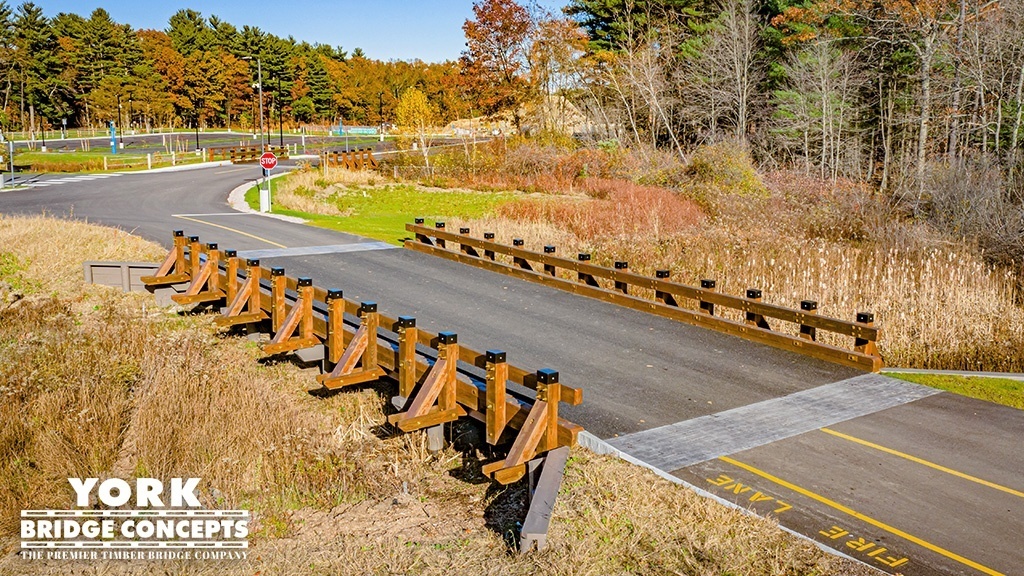
Minuteman High School Vehicular & Pedestrian Bridges – Lexington, MA

Discover the timber public school bridge at Minuteman High School—AASHTO-rated, low-impact, and inspired by the Old North Bridge.
June 19, 2018

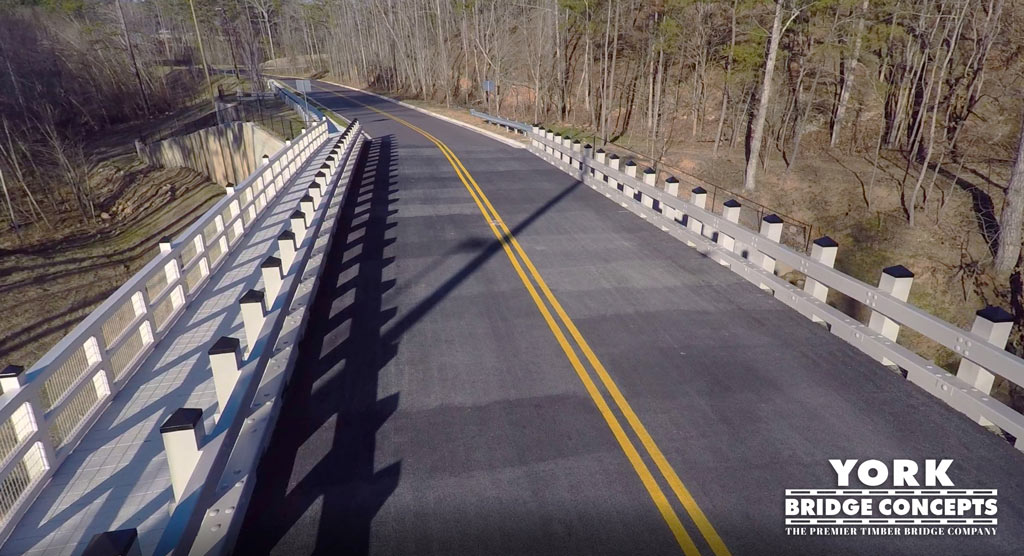
Inspired Living Vehicular Bridge – Alpharetta, GA

The Inspired Living Timber Vehicular Bridge is a shining example of how innovative engineering and sustainable construction practices can come together to create a functional and beautiful infrastructure solution.
July 6, 2017

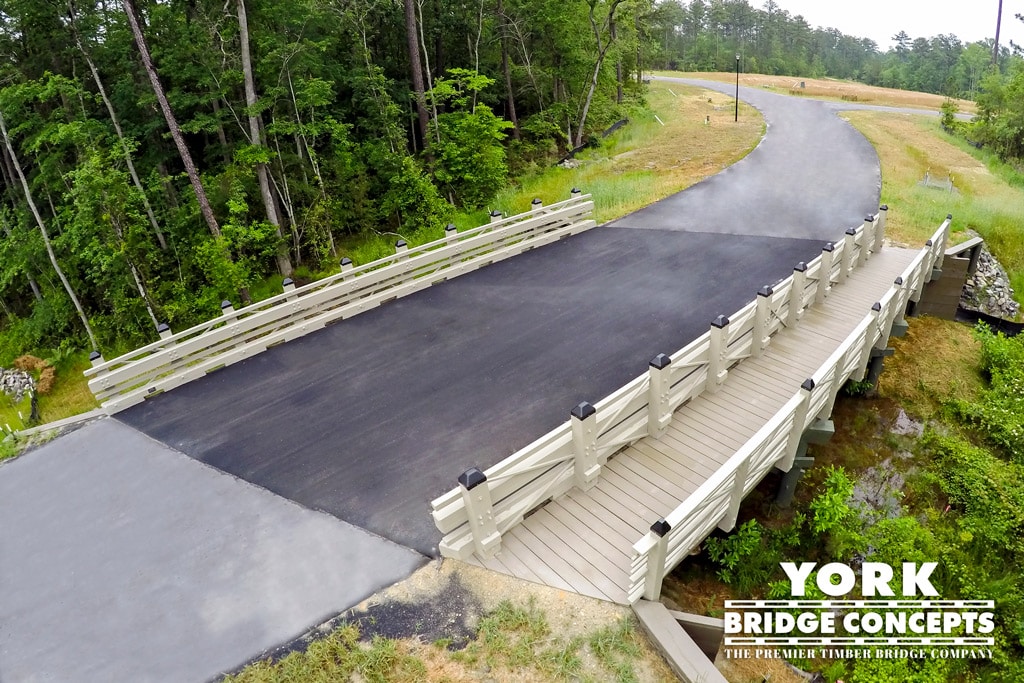
The Preserve at Worcester Vehicular Bridges – North Wales, PA

Discover how York Bridge Concepts built the Preserve at Worcester vehicular bridge using Legacy Series timber design and sustainable construction.