a Curved Legacy Series Crossing at the Heart of Groveland, Florida
Executive Summary
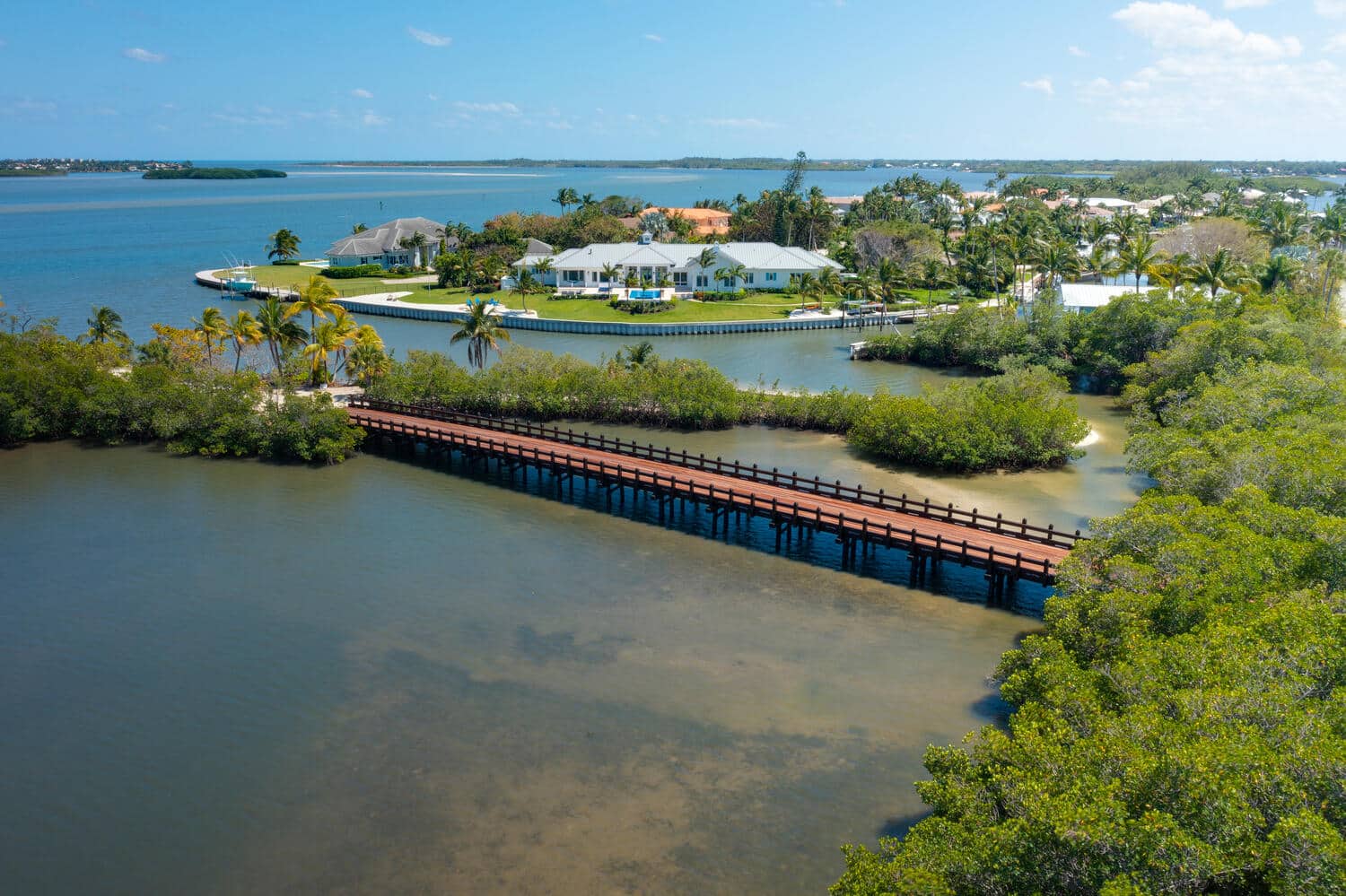
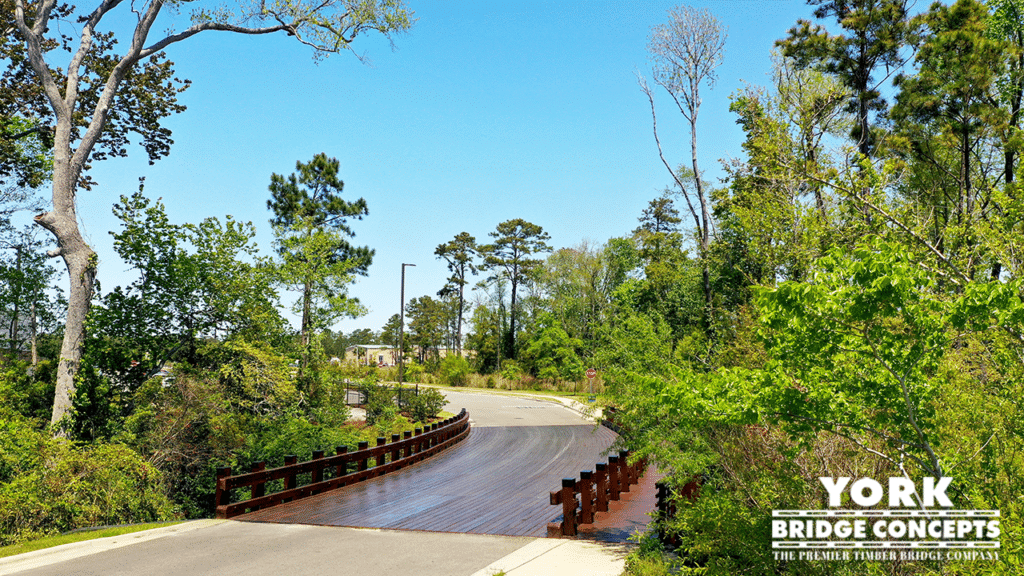
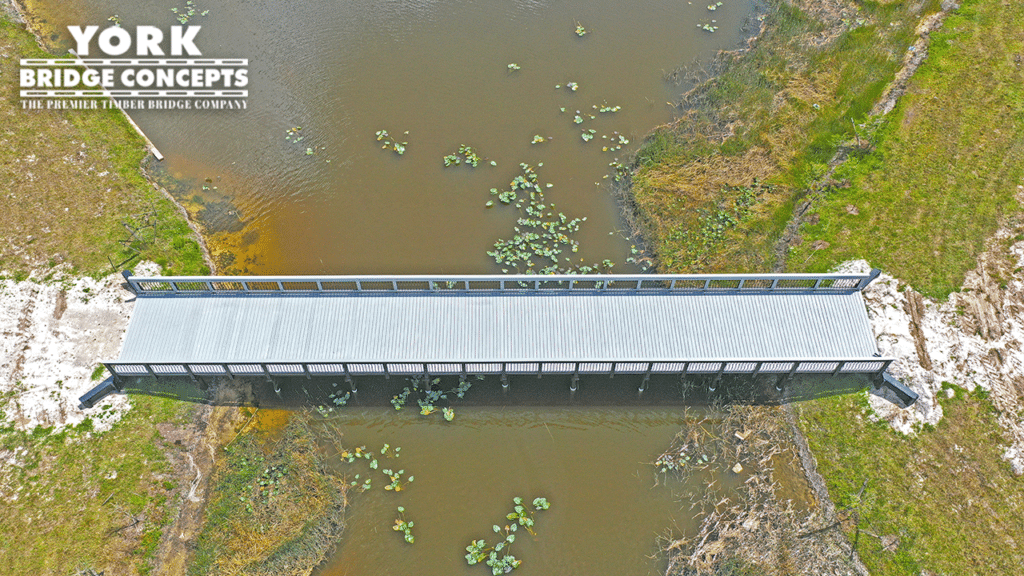
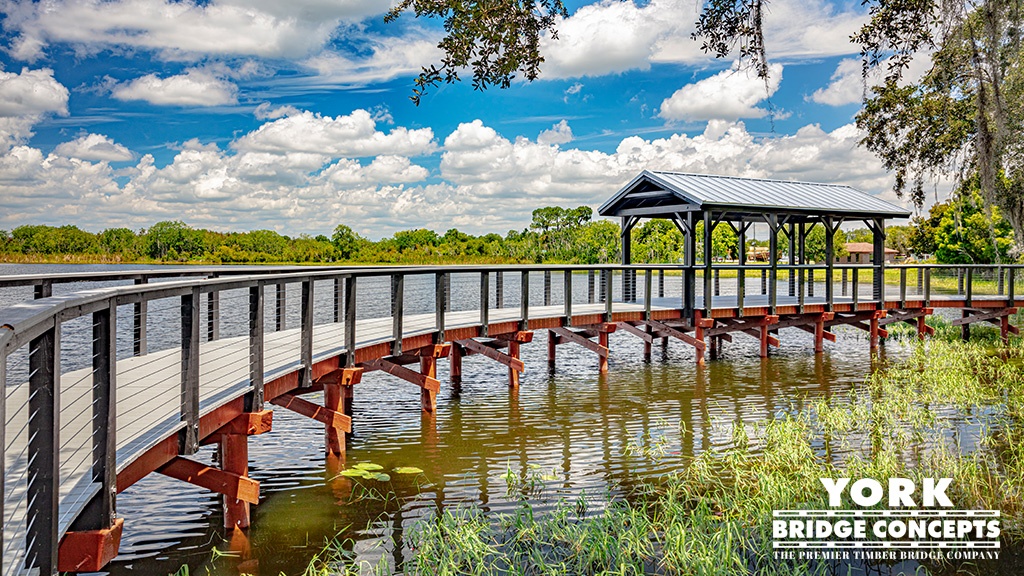
The Lake David Pedestrian Bridge is the signature element of a multi-year revitalization of Lake David Park in Groveland, Florida, just west of Orlando. Conceived as a graceful, repetitive-span timber crossing that arcs out over wetlands and skims the lake's edge, the bridge does more than move people from point A to point B--it reframes how residents and visitors experience sky, water, and shoreline. Designed and built by York Bridge Concepts (YBC) as part of our Legacy Series, the crossing features composite decking for long-term resilience, wire-rope handrail inset for an open, contemporary look, and a distinctive metal roof covered section placed at the apex of the curve to create a shaded overlook with panoramic views of Lake David. Structurally rated for 100 pounds per square foot (PSF) and sized to accommodate park maintenance carts, the bridge supports the daily cadence of community life--from morning jogs and birdwatching to weekend festivals--while protecting sensitive wetlands through our Deck-Level (Top-Down) Construction approach.
Specifications
- Width:
- 7'10" (7'4" clear)
- Length:
- 182'
- Height:
- 20' above grade
- Capacity:
- 100 PSF or 2-Ton GVW
- Construction:
- Deck Level
- Span Type:
- Repetitive Span
- Material:
- CCA/CA-C Treated Southern Yellow Pine & Composite
- Foundation:
- Timber Piles & Abutments (Acrylic/Polymer Coated where exposed)
- Stringers:
- SYP S4S Timber (Acrylic/Polymer Coated where exposed)
- Pedestrian Deck System:
- 1" Composite Deck
- Handrail:
- Decero™ Wire Rope Design Series
- Crossing:
- Lake
Project Context: A Park Reimagined Around Water
Lake David Park is the civic living room Groveland--a place to gather, play, and decompress beside a spring-fed lake. As the city invested in trails, playgrounds, launches, and event spaces, one design mandate rose to the top: link the park's destinations with a statement crossing that respects the ecology, amplifies the views, and signals that Groveland is investing in quality of life.
The resulting bridge threads these aspirations together. It arcs out from the shoreline in a gentle sweep, touching down lightly in the landscape and inviting pedestrians to follow their curiosity: what's beyond that curve, and how will the vantage shift as I walk? By projecting the deck over marshy foreshore, the alignment unlocks an experience that ground trails cannot--an elevated slice through reeds and ripples where visitors can watch light migrate across the lake and ospreys circle for fish.
Design Intent: A Curve That Feels Natural, Not Forced
Curved alignments are not simply aesthetic flourishes; they are tools for choreography. At Lake David, the plan curve accomplishes four things:
- Frames the view. The arc progressively reveals the lake, clubhouse lawn, and distant shoreline, turning the walk into a slow-motion panorama rather than a single fixed viewpoint.
- Avoids sensitive patches. The sweep was tuned to skirt pockets of vegetation and the softest soils limiting the number of penetrations in the wetland substrate.
- Calms foot traffic. Curves subtly slow movement, encouraging visitors to linger, look, and listen--especially at the shaded apex.
- Centers a destination. The roofed overlook anchors the midpoint as a "pause" in the journey, offering a place to gather out the sun without breaking the bridge's visual rhythm.
Why a Repetitive-Span Strategy
Repetitive spans--equal or near-equal bay lengths repeated across the alignment-deliver reliable constructability and an elegant visual cadence. At Lake David, this creates a heartbeat along the rail line: post, cable, post, cable. The pattern stabilizes the eye and underscores the bridge's gentle curvature without distracting from the water.
Structure & Capacity: Built for Crowds & Carts
Public-space bridges live many lives each day: quiet weekday strolls, stroller convoys at noon, and festival surges on weekends. The Lake David crossing is engineered for 100 PSF live load, a robust rating that comfortably supports dense pedestrian occupancy, and it is sized for park maintenance carts and light utility vehicles used for landscaping, trash collection, and event setup. The redundancy embedded in repetitive spans distributes loads efficiently, while framing and connections are detailed to handle vibration, wind, and service loads common to lakeside environments.
Comfort Underfoot
Pedestrian serviceability matters as much as ultimate strength. the deck and framing were tuned for perceptible comfort:
- Deflection limits appropriate to public occupancy reduce bounce.
- Dynamic response was considered so the bridge feels solid, not trampoline-like, even when joggers move in cadence.
- Deck acoustics are pleasantly subdued; composite's mass and surface texture help minimize the hollow "board clack" common on lighter structures.
The Apex Overlook: Shade, Sightlines, and Social Space
The covered section at mid-curve turns a beautiful walk into a destination. Think of it as a porch on the lake:
- Thermal Comfort: In Florida sun, shade expands dwell time. Parents can pause while kids watch turtles surface; photographers can frame shots without glare; seniors can rest comfortably before continuing across.
- Wayfinding Cue: The roof signals a midpoint and meeting point--"Let's meet at the pavilion on the bridge."
- Storm Moments: The metal roof offers temporary respite during passing showers, making the bridge a practical connector even when weather shifts.
Subtle widening under the roof (where site geometry allowed) increases passing width so that lingering visitors don't block circulation.
Handrail & Edge Design: Safety That Disappears
A wire-rope inset rail does three jobs elegantly:
- Keeps views open. Fine cables recede against water and sky, so the horizon remains unbroken.
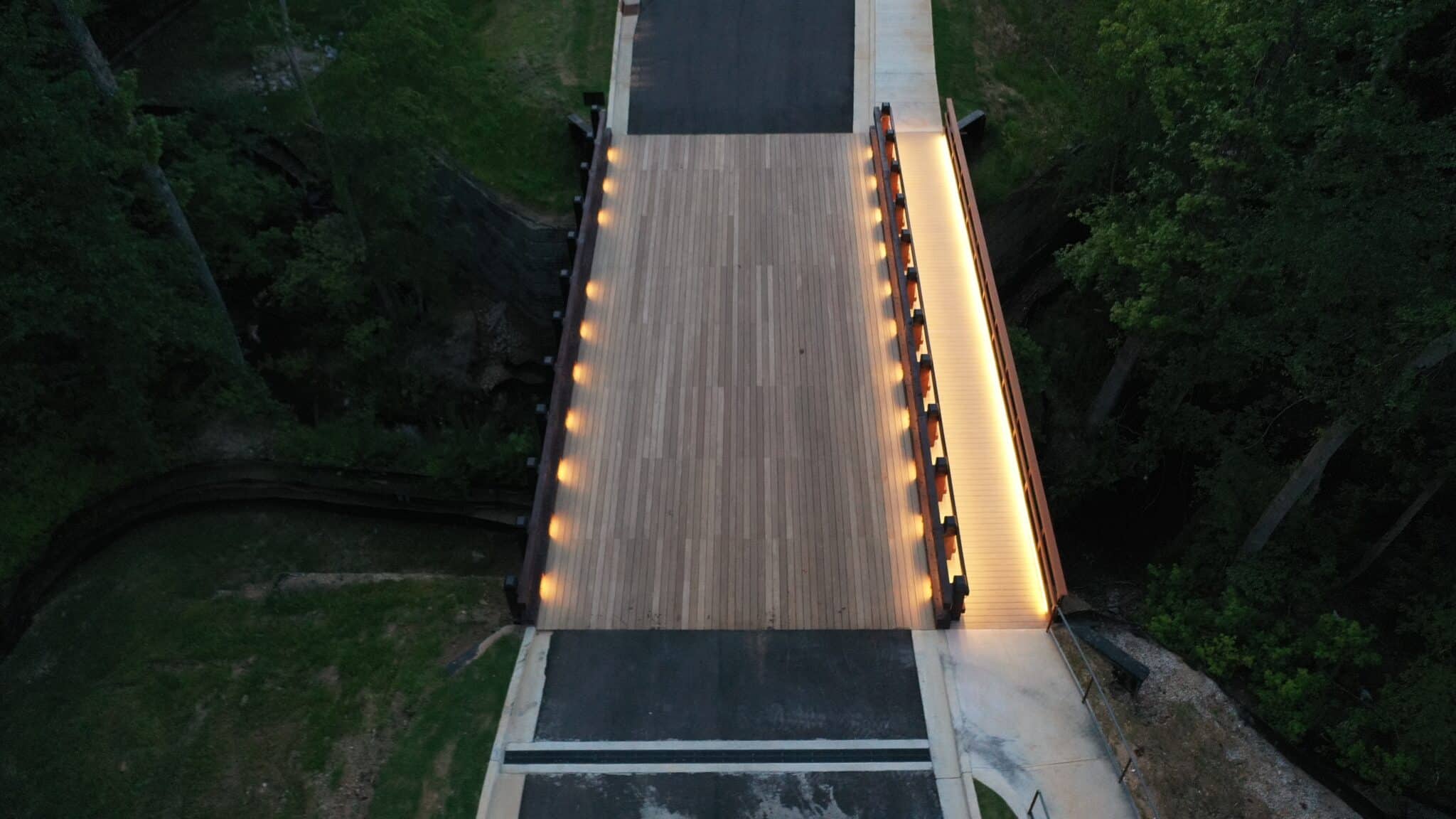
- Pairs with lighting. If architectural lighting is added, post-mounted fixtures can was the cable grid, reading as starry lattice at dusk without light spill into the lake.
- Simplifies maintenance. Cable tension can be checked quickly during inspections, and individual components are replaceable without deconstructing long runs.
Posts and cap rails are proportioned to feel secure under the hand, with smooth transitions at termini to avoid snag points for fishing gear, camera straps, and stroller canopies.
Decking: Performance Where People Live
Composite decking is a workhorse in waterfront parks. Here, it earns its keep by:
- Resisting Moisture Cycling: Dimensional stability reduces cupping/gaps through seasonal humidity.
- Simplifying Cleaning: Pollen, bird droppings, and festival debris hose off easily; light power-washing on a maintenance schedule keeps the deck looking fresh.
- Holding Traction: The surface texture maintains a pedestrian-friendly coefficient of friction--even after years of foot traffic--without the splinters common to weathered softwood planks.
Where the deck meets the roofed section, flashing and drip edges are detailed to prevent staining and to keep runoff from concentrating on localized board edges.
Foundations and Substructure: Light touch, Long Life
Lakeside soils can be a patchwork of organics, sands, and silts. YBC's approach begins with geotechnical reconnaissance and proceeds to foundations matched to the site's bearing qualities and environmental protections. The goals:
- Minimize Wetland Disturbance: Fewer, more efficient penetrations; use of construction mats and top-down staging; and careful vegetation avoidance.
- Design for Durability: Hot-dipped galvanization, stainless connectors where warranted, and protective coatings on substructure members in splash zones.
- Allow for Water Level Variability: Still elevations and hardware selections anticipate seasonal lake fluctuations and wind-driven surges.
Construction Method: Deck-Level (Top-Down) for Wetland Stewardship
YBC's Deck-Level (Top-Down) Construction limits ground disturbance by building the bridge from the bridge. The sequence, adapted for Lake David's shoreline ecology, follows a clean, repeatable rhythm:
- Access Staging at the Upland Edge: Materials are stockpiled upland to keep heavy equipment off sensitive soils.
- First Bay Set: Crews establish the initial foundation and framing from the bank, creating a safe platform above the wetland edge.
- Extend the Work Platform: With the first bay complete, tools and materials move onto the new deck; subsequent piers, beams, and deck panels are installed outward--one bay at a time.
- Handrail and Utilities: As structure pushes forward, rail posts and wire-rope hardware follow; any under-rail conduit or low-glare lighting is integrated with minimal drilling.
- Overlook Install: The roof structure is lifted and set once supporting bays are complete and verified for alignment and elevation, avoiding long ground booms.
- Finish and Clean: Protective mats are removed; disturbed edges are restored; punch-list items ensure the deck is free of snags, proud fasteners, or adhesive residues.
Top-down methods shorten the footprint of construction activity and help wetlands recover quickly after demobilization.
Safety, Accessibility, and Everyday Usability
A community bridge must feel inviting to all ages and abilities. Design considerations include:
- Predictable Grades: Gentle approach slopes make the crossing comfortable for wheelchairs, strollers, and bikes.
- Continuous Graspable Rails: Intuitive guidance for visitors with limited balance, with rail transitions that don't "pinch" users at turns.
- Clear Sightlines: The wire-rope inset keeps the horizon open, improving comfort for those with vestibular sensitivities and aiding passive surveillance for safety.
- Nighttime Wayfinding: If lighting is included, low-glare, shielded fixtures prioritize the deck plane and rail interior, limiting spill toward the lake to protect wildlife.
Operations & Maintenance: A Bridge That's Easy to Own
Public assets should be easy to care for. Lake David's bridge was detailed with maintenance in mind:
- Composite Decking Care: Periodic washdowns; inspection for fastener snugness; quick swap-out options for any isolated board damage.
- Wire-Rope System: Seasonal cable tension checks; visual inspection for kinks or corrosion; replacement of individual runs without dismantling full sections.
- Roof Section: Gutter and panel cleaning to prevent sediment buildup; fastener integrity checks after high-wind events; touch-up of protective coatings if required.
- Structural Review: Routine inspections focusing on bearing seats, connectors in splash zones, and any interface hardware near the roofed area.
Because the bridge is built to accommodate small maintenance carts, staff can bring tools and bins onto the deck without complicated access planning.
Environmental Stewardship: Building beside--and Above--Water
The bridge's value isn't just experiential; it's ecological. Key strategies include:
- Habitat Respect: Curved alignment avoids dense reed colonies and sensitive shallows; handrail transparency reduces the "wall" effect for bird movement.
- Light Discipline: If illumination is installed, spectra and aiming minimize disruption to fish and amphibian cycles.
- Runoff Management: Drip details at the roofed overlook, with thoughtful scuppering, spread water rather than concentrating discharge lines that could erode the edge.
- Construction Ethics: Top-down sequencing, silt protection where necessary, and strict limits on ground pressure keep the project's construction signature small.
Community Impact: A New Civic Icon
Residents quickly know when a public improvement "lands." The Lake David Pedestrian Bridge draws families at golden hour, anglers at dawn, and festival crowds on weekends. Its contributions stack up:
- Recreation: A safe promenade for walkers, runners, and sightseers who want a water experience without a boat.
- Tourism & Events: A photogenic backdrop for markets, concerts, regattas, and charity runs--helping local vendors and community groups thrive.
- Health & Wellness: Encourages steps, fresh air, and mindful pauses; the shaded overlook becomes a micro-oasis on hot days.
- Civic Identity: Instantly recognizable in photos and media, the bridge serves as a visual shorthand for Groveland's commitment to quality public spaces.
Visitor Experience: A Walk in Four Acts
- Approach: From the park path, the bridge ribs appear like a low-slung ribbon; the curve invites you to see what's beyond.
- Transition: As you step onto the deck, shoreline sounds soften; the handrail grid opens a wide, cinematic horizon.
- Apex: Under the metal roof, the temperature dips just enough to linger. You lean on the cap rail, read wind patterns on the water, and trace the flight line of a heron.
- Return: Heading back, the park lawn swells into view; the bridge recedes into a silhouette that feels both iconic and self-effacing--present, but never shouty.
Park Programming Possibilities
The bridge is not just infrastructure; it's a platform for community creativity:
- Nature Walks & School Programs: Teachers can stage quick lessons beneath the roof--shade, seating edges, and safe rail containment make it easy.
- Pop-Up Galleries: Temporary art installations along the rail can celebrate local artists without blocking views.
- Photo Spots: Discreet marker can identify portrait vantage points for weddings, graduations, and family sessions.
- Quiet Hours: Early-morning "quiet windows" can preserve moments for birders and anglers, balancing recreation with habitat respect.
Risk and Resilience: Designed for Florida Realities
Florida's weather is a crucible--intense sun, sudden storms, and episodic high winds. The Lake David crossing meets the moment with:
- Weathering Strategy: Composite decking and protected connectors resist corrosion and UV degradation.
- Drainage Discipline: Roof drip control and deck edges are detailed to shed water cleanly.
- Service Continuity: The 100PSF rating and allowance for maintenance carts enable swift post-event cleanup; crews can reach the overlook quickly to check fasteners after a storm.
Craft & Detailing: the Things You Notice Subconsciously
Small design choices ripple into the daily experience:
- Rail Cap Feel: Rounded edges and comfortable thickness make leaning pleasant, encouraging longer pauses and casual conversation.
- Post Rhythm: Regular spacing stabilizes visual flow; at the roofed section, the vertical cadence tightens to read "room-like" without feeling enclosed.
- Fastener Discipline: Exposed heads align; cuts are clean; end grain is sealed--signifiers of care that visitors may not name but always register.
Stakeholder Coordination
Bridges in public parks succeed when everyone is heard. YBC's process brings city leadership, parks staff, maintenance crews, environmental reviewers, and community members into a practical dialogue:
- Design Charrettes: Quick feedback loops on alignment and overlook placement.
- Mockups: Handrail and decking samples that stakeholders can touch and compare in sunlight.
- Maintenance Walkthroughs: Before opening day, crews test cart turns, hose connections, and cleaning routines on the actual deck.
Lifecycle Value: Cost You Feel vs. Cost You Don't
Initial cost is visible; lifecycle cost is often hidden. The Lake David design balances both:
- Lower Upkeep: Composite decking and replaceable cable components keep annual maintenance predictable.
- Service Flexibility: With cart access and straightforward details, city teams avoid specialized equipment for routine tasks.
- Longevity: Protective coatings, smart connections, and a repetitive-span framing system align with decades of use, not a few budget cycles.
Education & Interpretation
When a bridge becomes a classroom, civic pride grows. Consider low-profile interpretation that could accompany the project:
- Ecology Panels: Migratory birds, native plant species, and lake health tips.
- Design Notes: Why the bridge curves; how top-down construction protects wetlands.
- Civic Story: A short history of Lake David Park and the community effort behind its revitalization.
These elements can be integrated as small plaques at the approach or under the roofed overlook, preserving rail transparency.
Seasonal Life of the Bridge
- Spring: Anglers stake out the shaded lip; wildflowers along the bank mirror in the water.
- Summer: The roofed center becomes the town's unofficial front porch; sunset walkers share space with families returning form the splash pad.
- Autumn: Migratory arrivals animate the sky; light gets softer, and the curve reads bolder in long shadows.
- Winter: Crisp air brings clear horizons and quiet days; maintenance crews appreciate easy access for inspections between events.
Inclusive Design Consideratons
An inclusive bridge is intuitive and welcoming:
- Tactile Transitions: Changes in surface or subtle edge cues can alert low-vision visitors to the approach and to the shaded overlook area.
- Rest Logic: The roofed zone provides a predictable resting spot at mid-span.
- Psychological Safety: Open sightlines and gentle curves minimize blind corners; users can see who's ahead and behind reducing anxiety.
Opening Day to Year Ten: A Maintenance Snapshot
- Quarterly: Wash deck, inspect cables and posts, clear debris at the roof drip line.
- Annually: Confirm cable tensions; check connectors at bearing seats; review coating condition on exposed metal.
- After Major Storms: Rapid walk-through to verify roof panel fasteners, rail integrity, and any floating debris impacts.
- At Ten Years (Planning Horizon): Budget for strategic refreshes--isolated board replacements, hardware upgrades, or minor roof coating work as needed.
How the bridge Anchors a Bigger Park Vision
Because the bridge is both connector and destination, it helps the city unify program zones--playgrounds, lawns, launches, trails--into a legible whole. It also extends the usable day: morning shade draws walkers earlier; evening silhouettes draw photographers later; safe, comfortable passage keeps the park's edges active, discouraging the underuse that can lead to maintenance issues elsewhere.
Frequently Asked Questions
Is the bridge safe for large public events?
Yes. It's engineered for a 100PSF live load, which is a robust public-assembly standard for pedestrian bridges. The repetitive-span framing and connection detailing ensure comfortable service performance under crowd conditions.
Can maintenance carts use the bridge without causing damage?
Yes. The bridge allows for typical park maintenance carts and light utility vehicles. Wheel loads and turning radii were considered so crews can service the park efficiently without special access planning.
Why use composite decking instead of all-wood planks?
In a lakeside Florida environment, composite reduces long-term maintenance, resists rot and surface checking, and sustains slip resistance. That means predictable upkeep and a consistently safe walking surface.
What's the purpose of the roofed section in the middle?
It creates thermal comfort, a social pause point, and wayfinding landmark. On hot days or during quick showers, visitors have a dignified place to rest and enjoy the lake view without leaving the bridge.
How did construction protect the wetlands?
YBC used a Deck-Level (Top-Down) sequence--building outward from completed bays--so workers and materials stayed on the deck instead of the ground. This approach substantially reduces wetland disturbance.
Will the wire-rope rail obstruct views in photos?
No. That's the point. The cable grid keeps horizons open while meeting safety requirements. It reads as a fine lattice in person and virtually disappears in wide-angle photos.
A Day on the Bridge: Vignette
At first light, anglers amble out, cradling thermoses. A breeze combs the water as herons patrol the shallows. By eight, joggers give way to strollers and coffee cups; a toddler presses palms to the cool cap rail under the metal roof, squealing at a turtle's nose breaking the surface. Noon heat pushes people into the shade; a maintenance cart hums across, staffs the event lawn, and rolls back with planters in tow. At dusk, couples lean into the balustrade, and phones lift toward a sherbet sky. The bridge absorbs it all-quiet, crowds, carts--without asking for attention. It simply holds the moment.
Why YBC: A Partner for Civic Places
York Bridge Concepts designs, engineers, and builds pedestrian and vehicular timber bridges that solve real site problems without losing the poetry of place. For Lake David, that meant:
- Listening to the Park's Needs: A bridge that is a centerpiece, not a barrier.
- Respecting the Ecology: Curved alignment, minimized disturbance, sensitive construction.
- Delivering Longevity: Composite decking, replaceable rail components, and robust live-load capacity.
The result is a civic asset that will earn its keep for decades--quietly raising the quality of everyday life in Groveland.
Closing Perspective
The Lake David Pedestrian Bridge distills the promise of public design in one elegant move: invite people closer to water while protecting the landscapes that make water worth visiting. Its curved plan is not just beautiful; it's smart. Its shaded apex is not just comfortable; it's communal. Its details are not just refined; they're maintainable. In a single structure, Groveland gained a connector, an overlook, and an icon--proof that when infrastructure is crafted with care, it becomes part of the community's story.
All Feature Projects
What's Best: A Culvert Or A Timber Bridge?
What Is The Best Span Type For My Project?
Which Load Capacity I Need?
How Do I Cross An Environmentally Sensitive Area?
How Do I Create A Landmark?
How Long Does A Timber Bridge Last?
Culvert Or Bridge
If you're considering using a culvert for your crossing project. Click below to understand the best fit for your project.

Spanning Solutions
Spanning a crossing is one of the most important aspects of your crossing project. Find the best solution for your crossing needs.

Uses & Capacities
The load capacity of a timber bridge may surprise you. See specs for different loads and uses that will help your decision-making process.