Douglas & Gates Covered Boardwalk in Acton, Massachusetts
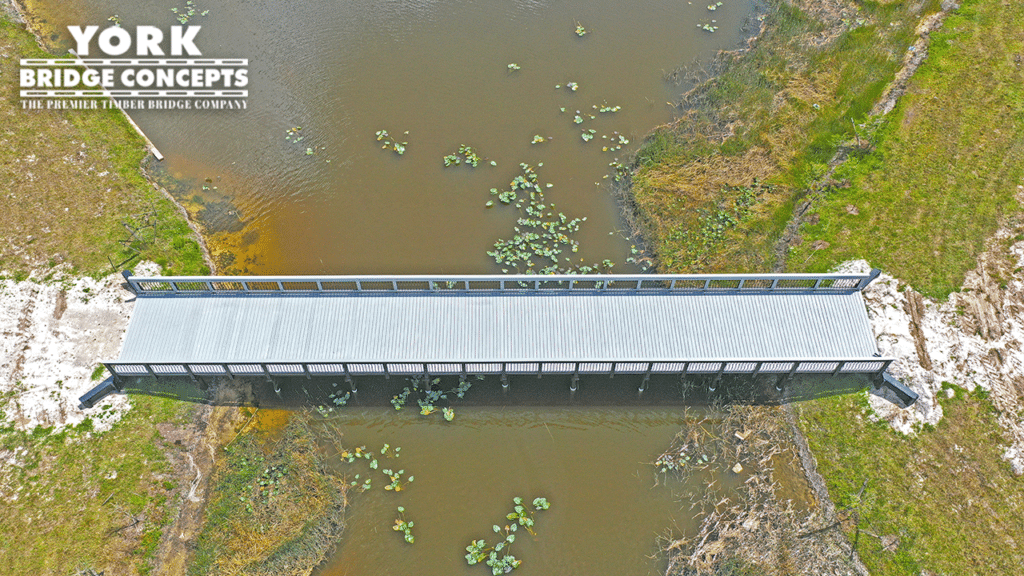
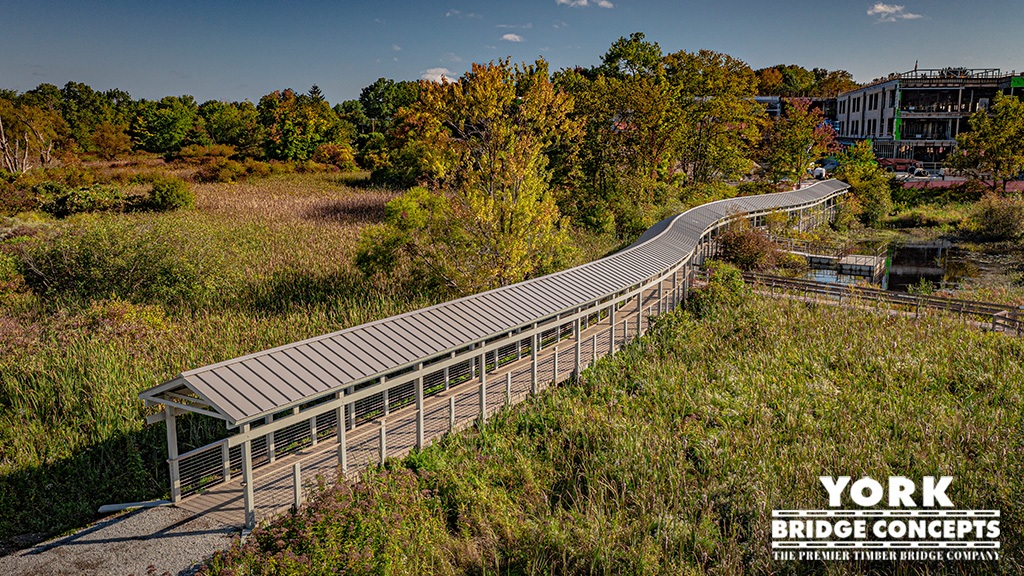
The Douglas & Gates covered boardwalk was conceived with Arrowstreet as more than a path from point A to B--it's a reliable, everyday mobility link tailored to the rhythms of a school community. As students and families move between the Indian Hills neighborhood and the newly envisioned Douglas Gates Elementary School, the boardwalk offers a safe, weather-conscious, and dignified route that respects the surrounding wetlands. York Bridge Concepts' Decero™ Design Studio developed a solution that integrates structure, landscape, and user experience into a continuous, legible sequence: gentle approaches, a calm mid-span experience above the water and vegetation, and a comfortable arrival at the school side. The overhead metal roof canopy protects and guides users, while the warm gray palette with a golden-brown deck reinforces the school's contemporary design language.
Specifications
- Width:
- 7'10" (7'8" clear)
- Length:
- 280'
- Height:
- 5' above grade
- Capacity:
- 90 PSF
- Construction:
- Deck Level
- Span Type:
- Mulitple Span
- Material:
- CCA / CA-C / Penta C Treated Southern Yellow Pine & Composite
- Foundation:
- Timber Piles & Abutments (Acrylic/Polymer Coated where exposed)
- Stringers:
- SYP S4S Glulams & Rough Sawn Timber (Acrylic/Polymer Coated where exposed)
- Deck System:
- 1" Composite Deck
- Handrail:
- Decero™ Wire Rope Design Series
- Crossing:
- Stream / Wetlands
The Setting & Community Context of Douglas Gates
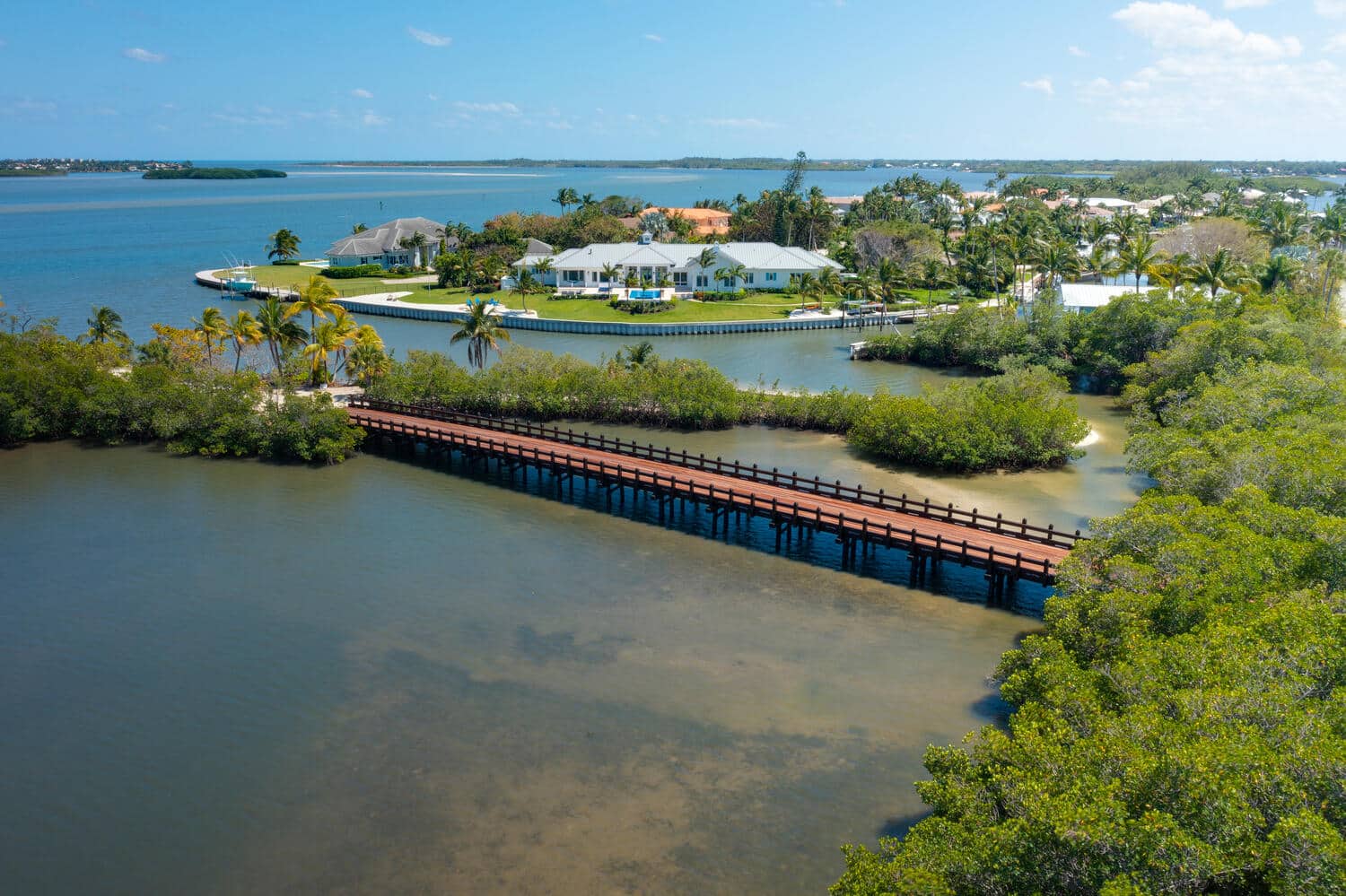
Acton's outdoor spaces are both amenity and classroom. The wetlands adjoining the school are part of a living ecology that changes by season and by weather. Locating a daily route through this landscape requires sensitivity: families need a dependable all-weather crossing, and the wetlands require a design that preserves hydrology and habitat. This project brings those priorities together, creating a walking experience that feels intuitive and safe, yet also quietly educational--students can observe seasonal water levels, bird activity, and leaf-out patterns, all while traveling along a structure purpose-built to leave a light footprint.
Design Intent & Aesthetic Alignment
From the outset, the design mandate blended restraint and detail. The boardwalk "coasts" just above the vegetation, minimizing visual intrusion while offering clear edge definition via horizontal handrails with wire rope infill. That linear handrail language mirrors the school's modern composition--long, clean lines, uncluttered joints, and a consistent rhythm that reads as one cohesive piece from end to end. The golden-brown deck tone is intentional: it warms the experience during New England's gray months and harmonizes with the canopy's cooler grays to create a balanced, contemporary aesthetic. Where the boardwalk passes over pond edges and wet meadow zones, the line remains trim and unfussy so the focus stays on the landscape and the journey.
Safe Access, Every Day
A school connector must perform on ordinary days and in extraordinary weather. The boardwalk width, edge conditions, and clear sightlines are arranged to accommodate the morning and afternoon peaks when parents, caregivers, and students converge in both directions. Handrails, a low-profile pedestrian curb, and a canopy that sheds precipitation away from the walking surface all work together to reduce conflict points and uncertainty. The route feels intuitive, which supports independent mobility for older students while keeping younger walkers closely guided. Modest transitions at landings and approaches reduce tripping hazards and help maintain a steady pedestrian "flow," even when backpacks, scooters, and strollers mix together at the same time.
Environmental Stewardship in a Wetland Context
Designing in wetlands is an exercise in humility. The boardwalk's elevation allows water to move, vegetation to grow, and wildlife to persist beneath and around the structure. Pier spacing and substructure alignment are coordinated to maintain sunlight penetration, encourage air flow, and avoid creating stagnant pockets. Selected coatings and finishes are chosen for durability and environmental prudence, reducing maintenance cycles and limiting site disturbances over the life of the structure. Where habitat edges are sensitive, the boardwalk edges remain simple so the human presence reads as a narrow line rather than a broad platform. The result is a crossing that "belongs" without dominating.
Structure & Materials
York Bridge Concepts specializes in timber-forward and composite solutions that combine strength, resilience, and warmth. For this project, the structural strategy emphasizes predictable performance in a high-use public setting. Primary members and connections are detailed to manage repetitive pedestrian loading and New England weather cycles--freeze/thaw, wind and periodic icing. Hardware and connectors are specified for corrosion resistance, while visible elements maintain the refined, linear aesthetic introduced by the handrails. Finish systems are selected to resist UV, precipitation, and snowmelt chemicals encountered in winter maintenance, protecting both performance and appearance. The outcome is a boardwalk that looks purposeful up close and cohesive from a distance.
Roof Canopy Performance & Detailing
The metal roof canopy is the project's signature feature. It's calibrated to do three jobs at once: keep precipitation off the walking surface, provide shade and visual comfort, and signal the route in low-contrast light conditions. The canopy's clean fascia and soffit lines read from afar, helping wayfinding during hurried morning drop-offs and late-afternoon pickups. Downward-directed drip paths are managed so water sheds away from high-traffic zones, supporting slip resistance and reducing splash-back onto the handrails and curb. The canopy proportions are deliberately light--the structure feels protective without enclosing the space, preserving long views across the ponds and meadows.
Accessibility & Universal Design
A daily school route must welcome every user. Slopes, cross-slopes, transitions, and landings are laid out to support mobility devices, strollers, and small bicycles. Handrail heights and graspability work for a wide age range, and the pedestrian curb provides edge awareness for younger walkers while still accommodating maintenance carts as needed. Surface textures are chosen for reliable underfoot traction through season changes and after precipitation events. Clear width and passing space planning prevent congestion, especially at approaches and canopy edges where users naturally slow down to shake off rain or adjust backpacks and coats.
Construction Approach: On-Site, Deck-Level Execution
York Bridge Concepts delivers projects where the construction method respects the site as much as the finished structure does. For the Douglas Gates boardwalk, an on-site, deck-level construction sequence reduces ground disturbance and heavy equipment exposure to wetlands. Crews work from the alignment itself, advancing the structure outward as foundations and substructure are installed. This approach compresses the construction footprint and eliminates the need for large temporary access roads in sensitive areas. Materials are staged to minimize handling, and work windows are planned to coordinate with school operations and seasonal environmental considerations.
Foundations & Pile Installation
In wetland contexts, foundation strategies drive success. Piles are installed using a vibratory hammer mounted to an excavator, a method that achieves target embedment efficiently while reducing noise and avoiding impact driving shock loads to the surrounding environment. Alignment and verticality are closely monitored to maintain the crisp handrail lines and canopy geometry established in the design phase. Once piles reach bearing criteria, caps and stringers lock in the boardwalk's linear expression, ready to receive the deck and rail system. Each phase is checked against tolerances that preserve both performance and the minimalist aesthetic.
Hydrology, Drainage, & Resilience
Water wants to move, and the boardwalk lets it. Pier spacing, deck elevation, and the absence of broad solid under-surfaces support natural flows, reducing scour and discouraging debris accumulation. The roof canopy improves drainage behavior by keeping portions of the deck drier during storms, which in turn limits freeze-thaw cycling at the walking surface. Where the boardwalk meets land, transitional grading and edge detailing prevent ponding and keep the pedestrian realm clear. These small, disciplined choices compound into a more resilient crossing with fewer maintenance surprises after major weather events.
Winter Performance & New England Climate
Acton's winters informed the detailing from day one. The boardwalk leverages a deck surface that maintains traction in cold, wet conditions and sheds meltwater predictably when temperatures rise above freezing. The canopy mitigates direct snow loading on the deck and reduces the frequency of ice formation by diverting precipitation off the primary walking line. Handrails remain comfortable to the touch, with profiles that discourage ice sheathing and allow safe grasping even after flurries. The intent is straightforward: families should experience a consistent, dependable surface year-round, not a sequence of seasonal exceptions.
Lighting, Wayfinding, & Security
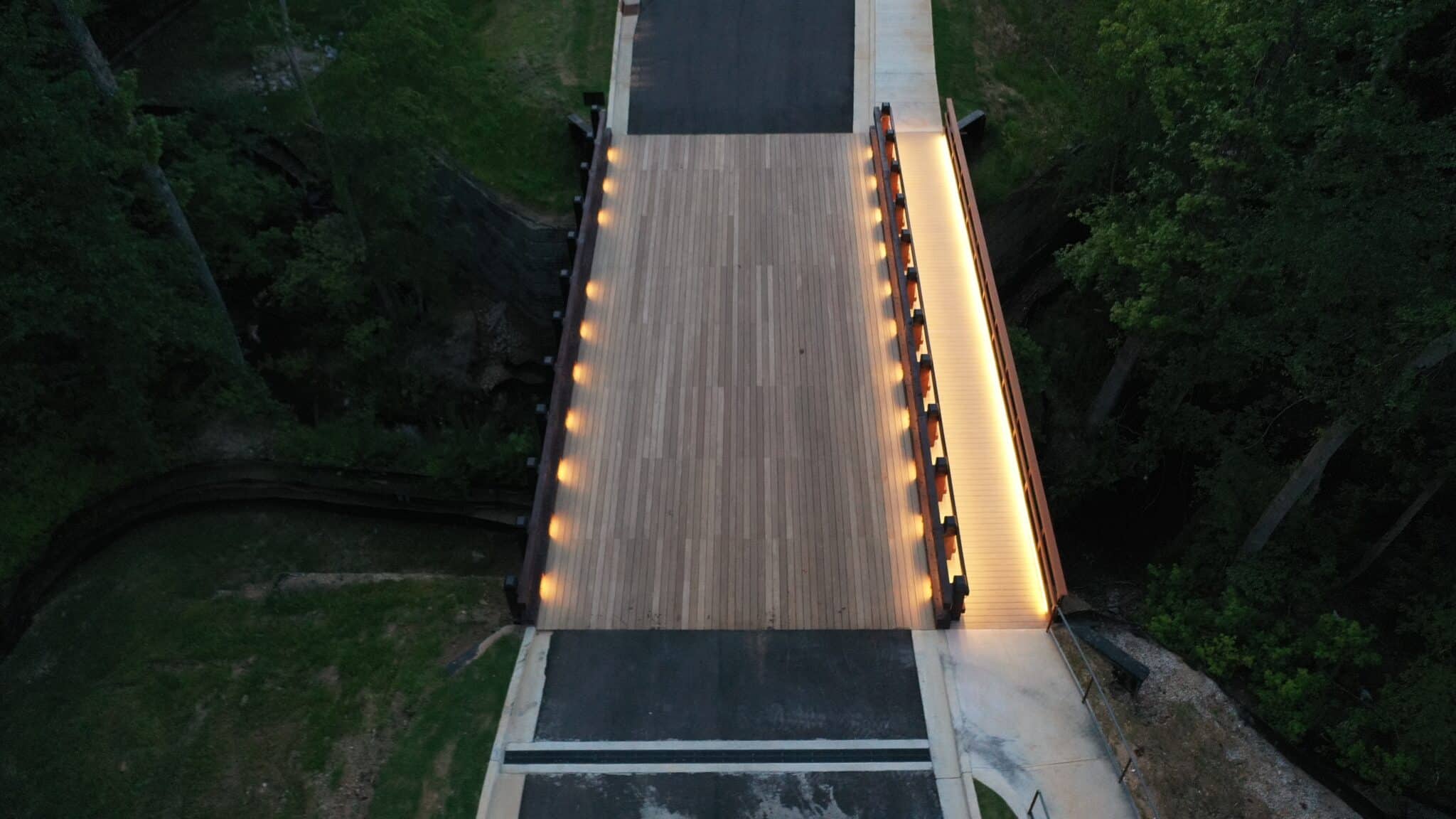
Subtle, down-cast lighting enhances early-morning and late-afternoon visibility without washing the wetland in glare. The canopy and handrail system offer logical mounting locations while shielding light from upward spill. Even illumination supports depth perception and face recognition along the route, contributing to a sense of security. Wayfinding relies on the design itself: the boardwalk's crisp alignment and the canopy's recognizable profile make the path obvious from a distance, reducing the need for excessive signage in the landscape.
Operations, Maintenance & Longevity
A school connector must be uncomplicated to operate and maintain. The boardwalk system prioritizes durable finishes, accessible fasteners, and clear drainage paths so routine inspections are fast and productive. Where periodic cleaning is required, the canopy and rail geometry allow standard equipment to work efficiently without specialized attachments. Surface renewals and spot touch-ups can be scheduled around the school calendar, minimizing disruption. The overarching maintenance philosophy is to extend life by protecting the structure from the predictable stresses of sun, water, ice, and daily foot traffic--an approach that conserves budgets and ensures reliability for decades.
Stakeholder Collaboration & Permitting
Delivering an educational link through wetlands touches many stakeholders. York Bridge Concepts' process brings the school district, design consultants, environmental reviewers, and construction partners into a tight feedback loop. Early alignment on goals--safety, resilience, minimal disturbance--keeps the project pointed at outcomes everyone can agree on. Meetings and site walks are used to validate assumptions about plant communities, water behavior, and user patterns. The result is not just a set of approvals but a shared understanding of why specific details matter, from canopy fascia edges to the spacing of wire rope infill.
The Decero™ Difference
Decero™--"from scratch"--is more than a tagline for York Bridge Concepts. It's a commitment to treating each crossing as a custom response to a particular site, program, and community. For Douglas Gates, Decero™ meant designing a boardwalk that would feel inevitable once built, as if it had always been the sensible way to move through the wetlands. The team translated school design cues into rail geometry and color, tuned the canopy to the microclimate of the ponds, and honed construction methods to the project's environmental sensitivities. Every line you see is the result of that deliberate, ground-up process.
User Experience: Calm, Predictable, Human-Scaled
A great school connector does not force attention to itself; it supports a smooth morning routine. The boardwalk's deck reads as one continuous plane, with tactile cues at edges and transitions that quietly communicate where to step and where to pause. The canopy frames the sky without dominating it, so the crossing feels safe but not confined. Mid-span, the views open to water and vegetation, providing a moment of respite before re-entering the bustle of drop-off areas. On rainy days, shelter feels close at hand; on bright days, the route feels open and cheerful. These qualities add up to a daily experience that parents children can trust.
Detailing the Handrail & Wire Rope System
The horizontal handrail with wire rope infill is a defining element. The horizontal underscores the boardwalk's linear motion while the cable infill preserves clear sightlines to the wetland. Posts are set to a calm rhythm that aligns with deck modules and canopy structure, creating visual order without fuss. Junctions and terminations are handled with care, ensuring the eye does not snag on bulky hardware. The profile is both contemporary and approachable--refined enough to resonate with the school's architecture, and simple enough to fade into the background when the landscape takes center stage.
Managing Edges & Approaches
Approaches to any boardwalk are where most user friction occurs. Slopes transition gently from grade to structure, and edge conditions are shaped to discourage off-path shortcuts that can damage vegetation. The pedestrian curb adds a dependable tactile edge, helpful for younger students learning to walk the route independently. At the same time, clear width and rail geometry keep the experience open and inviting, avoiding the "corridor" feeling that can come with narrower paths. The goal is to make the start and end of the journey as calm as the middle.
Construction Sequencing Around a School Calendar
Building next to an active school community requires choreography. York Bridge Concepts planned deliveries, staging, and noisier operations to avoid peak school activity windows. Communication with administrators and facilities teams ensured that milestone operations--like canopy set-out or pile installation--were scheduled when they would be least disruptive. The on-site, deck-level methodology further reduced the footprint and kept access routes clear for school functions, emergency services, and neighborhood traffic.
Quality Assurance & Field Verification
Structure and finish quality are confirmed at each step so adjustments can be made long before they become visible issues. After pile installation with the vibratory hammer and alignment verification, caps and stringers are checked against a tight tolerance band to preserve the boardwalk's crisp sightlines. Deck installation follows a verified pattern to ensure consistent spacing,
Community Benefits Beyond the Walk
Although the boardwalk is a daily route, it also functions as a small public space. Teachers can use it as an outdoor learning corridor, pausing to discuss plant identification, water cycles, or local bird species. Families walking home after school events experience the wetlands at twilight under gentle, shielded lighting. Over time, the crossing builds a shared memory for the community--a place where the school's identity meets the town's natural character. That intangible value is part of the project's success.
Durability, Stewardship, & Budget Confidence
Long-term durability is embedded in the detailing: corrosion-resistant hardware, protective finish systems, proper drainage pathways, and accessible inspection points. By reducing the frequency of disruptive maintenance, the school district gains budget predictability and fewer closures. When maintenance is required, crews can access fasteners and components without dismantling broad sections of the structure. That ease of stewardship protects the original investment and preserves the boardwalk's appearance year after year.
Safety Culture & Risk Management
Safety is designed into the geometry and into the construction process. During building, the on-site deck-level approach limits exposure to saturated soils and steep edges. After completion, the steady rail rhythm, tactile curb, and canopy protection reduce common pedestrian risks: slips on wet decking, glare on bright days, and confusion at intersections. Clear sightlines also support natural surveillance--you can see where you're going and who's coming toward you. For a school connector, these are more than design preferences; they are risk-management strategies that pay dividends daily.
Coordinated Finishes & Color Strategy
The palette of warm grays with a golden-brown deck isn't only about visual appeal. It's a strategy for longevity and legibility. Mid-tone grays soften the presence of metal elements while hiding routine scuffs and weathering. The warmer deck read helps users read the walking plane in dim light and after precipitation. Across seasons--snow cover, leaf drop, spring growth--the palette remains consistent and composed, which helps the route feel welcoming without constant cosmetic touch-ups.
A Daily Invitation to Walk
Infrastructure can change habits. By making the safest route the most pleasant one, the boardwalk encourages more families to choose walking over short car trips. That shift reduces congestion around the school at peak times, lowers localized emissions, and builds independence among students who can confidently travel with friends or siblings. The crossing acts as a daily invitation to step outside, notice the landscape, and arrive ready to learn.
Project Outcomes
The Douglas & gates boardwalk and canopy deliver on the project's central promises: a safer, more comfortable connection for students and families, a design language aligned with the new school, and a construction approach that respects the wetlands. The result is a resilient piece of public infrastructure that looks as if it belongs--because it was designed for this exact place and purpose. Over time, as the vegetation grows and the school community settles into its routines, the boardwalk's quiet clarity will continue to support thousands of daily moments that add up to a healthier, more connected campus.
Looking Ahead
Great school routes become invisible when they work well--no longer a "project," but a part of everyday life. The Douglas & Gates boardwalk is built for that long view, combining durability, maintainability, and timeless detailing. As Acton evolves, this crossing will continue to serve as a model of how to thread safe mobility through sensitive landscapes without compromise.
All Feature Projects
What's Best: A Culvert Or A Timber Bridge?
What Is The Best Span Type For My Project?
Which Load Capacity I Need?
How Do I Cross An Environmentally Sensitive Area?
How Do I Create A Landmark?
How Long Does A Timber Bridge Last?
Culvert Or Bridge
If you're considering using a culvert for your crossing project. Click below to understand the best fit for your project.

Spanning Solutions
Spanning a crossing is one of the most important aspects of your crossing project. Find the best solution for your crossing needs.

Uses & Capacities
The load capacity of a timber bridge may surprise you. See specs for different loads and uses that will help your decision-making process.