
June 24, 2025


Discover how York Bridge Concepts’ 45-ft Southern Yellow Pine pedestrian bridge unites Ashburn Place trails with timeless mahogany-stained beauty.



The most successful community infrastructure projects do more than solve a transportation challenge—they improve how residents experience their neighborhood every day.
The Ashburn Place Pedestrian Bridge in Ashburn, Virginia, exemplifies this approach. Designed and constructed by York Bridge Concepts, this custom timber footbridge transformed a natural barrier into a community asset, creating a safer, more accessible connection between neighborhood trails while preserving the character of the surrounding landscape. The bridge spans a wooded ravine that previously forced residents to take lengthy detours through residential streets to reach nearby walking paths and community amenities.
Today, the bridge serves as both a practical transportation link and a visual landmark that enhances community connectivity, encourages outdoor recreation, and supports the walkable lifestyle residents increasingly value.
Located within the Ashburn Place community developed by M/I Homes, the bridge was designed to reconnect portions of the neighborhood trail network while preserving the natural beauty of the ravine below. Rather than disrupting the landscape, York Bridge Concepts created a timber pedestrian bridge that feels like a natural extension of the environment.
Many residential communities contain natural features that create barriers to movement.
Streams, ravines, wetlands, and drainage corridors often interrupt trail systems and limit connectivity between neighborhoods and amenities. In Ashburn Place, residents were forced to navigate steep terrain or travel around several blocks of neighborhood streets to reach destinations on the opposite side of the ravine.
The Ashburn Place Pedestrian Bridge solved this challenge by:
The result is infrastructure that improves quality of life while preserving the natural landscape residents enjoy.
Homeowner Associations often face unique infrastructure challenges.
Projects must balance:
The Ashburn Place HOA sought a solution that would enhance connectivity while minimizing long-term maintenance obligations and preserving the neighborhood’s natural character. York Bridge Concepts responded with a custom timber bridge designed specifically for the community’s goals and environmental conditions.
The bridge utilizes pressure-treated Southern Yellow Pine, a material recognized for its strength, durability, and natural beauty.
Benefits of Southern Yellow Pine include:
The bridge’s rich mahogany stain further enhances the visual appeal while helping protect the timber from weathering and UV exposure.
The Ashburn Place Pedestrian Bridge was designed to complement the surrounding homes and neighborhood character.
Distinctive features include:
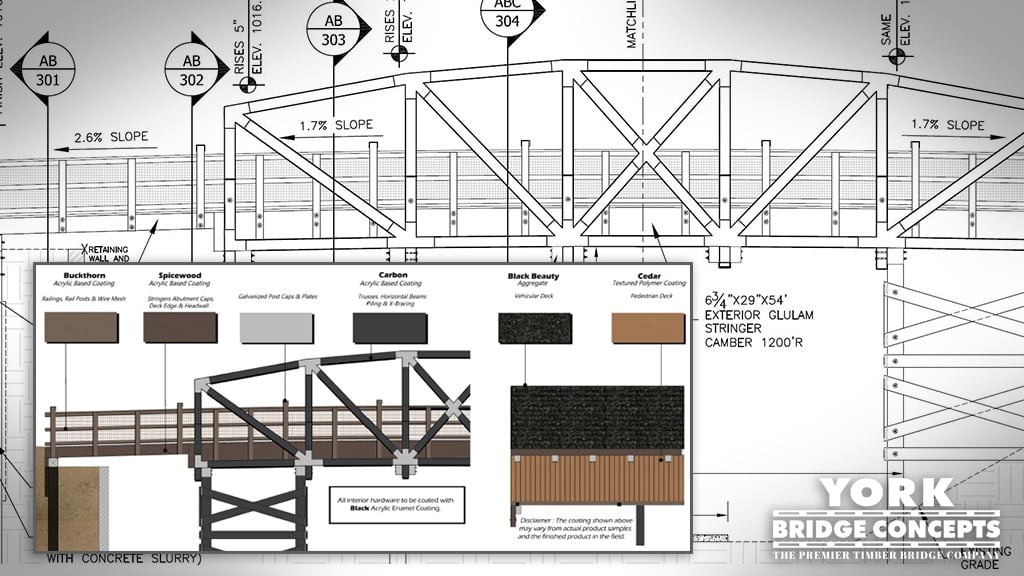
The deep mahogany finish creates a sophisticated appearance that coordinates with nearby architectural elements and enhances the natural beauty of the timber.
Custom powder-coated metal pile caps add visual refinement while helping protect structural components from moisture and weather exposure. Some caps incorporate integrated lighting features that enhance safety and nighttime aesthetics.
The Decero™ Picket Rail system provides a timeless appearance that complements the neighborhood’s residential architecture while meeting modern safety requirements.
The bridge incorporates a subtle upward curve that improves drainage, enhances aesthetics, and creates a lighter visual presence within the landscape.
One of the most significant advantages of the Ashburn Place project was York Bridge Concepts’ proprietary Deck-Level Construction™ methodology.
Rather than requiring extensive access roads and heavy equipment within the ravine, construction advanced from the bridge deck itself. This approach minimized disturbance to:
This environmentally sensitive construction method helped preserve the ecological integrity of the site while improving construction efficiency.
Modern homebuyers increasingly seek neighborhoods that encourage walking, outdoor recreation, and connectivity.
Pedestrian bridges play an important role in creating:
The Ashburn Place Pedestrian Bridge demonstrates how a relatively modest infrastructure investment can significantly improve the resident experience while increasing the value of community amenities.
The success of the Ashburn Place Pedestrian Bridge highlights a broader trend within residential development.
Developers, HOAs, and municipalities increasingly recognize that infrastructure should not merely solve transportation problems—it should improve how people interact with their communities.
Projects like Ashburn Place show how pedestrian bridges can:
York Bridge Concepts continues to apply these principles across communities throughout North America.
For more than 40 years, York Bridge Concepts has helped communities create meaningful connections through custom bridge design and construction.
Clients choose York Bridge Concepts because of our:
From neighborhood trail crossings and HOA projects to parks, campuses, resorts, and master-planned communities, York Bridge Concepts delivers infrastructure that enhances both function and experience.
The Ashburn Place Pedestrian Bridge demonstrates how thoughtful infrastructure can transform a simple crossing into a valued community amenity.
By combining sustainable construction, architectural craftsmanship, and community-focused design, York Bridge Concepts created a bridge that not only spans a ravine but also strengthens connections between neighbors, trails, and everyday experiences.
Whether your project involves a residential community, HOA improvement initiative, trail network, park system, or neighborhood amenity, York Bridge Concepts can help create a custom pedestrian bridge solution that delivers lasting value.
This website uses cookies
We use cookies to personalise content and ads, to provide social media features and to analyse our traffic. We also share information about your use of our site with our social media, advertising and analytics partners who may combine it with other information that you’ve provided to them or that they’ve collected from your use of their services.
Cookies are small text files that can be used by websites to make a user's experience more efficient.
The law states that we can store cookies on your device if they are strictly necessary for the operation of this site. For all other types of cookies we need your permission. This means that cookies which are categorized as necessary, are processed based on GDPR Art. 6 (1) (f). All other cookies, meaning those from the categories preferences and marketing, are processed based on GDPR Art. 6 (1) (a) GDPR.
This site uses different types of cookies. Some cookies are placed by third party services that appear on our pages.
You can at any time change or withdraw your consent from the Cookie Declaration on our website.
Learn more about who we are, how you can contact us and how we process personal data in our Privacy Policy.
Please state your consent ID and date when you contact us regarding your consent.