November 13, 2020
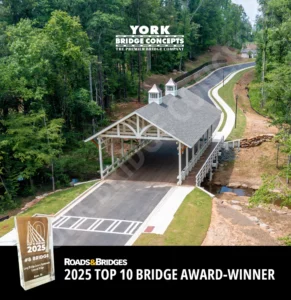
Discover the Legacy timber vehicular bridge at Bishop’s Landing with dual pedestrian walkways—sustainable, scenic, and built to last.


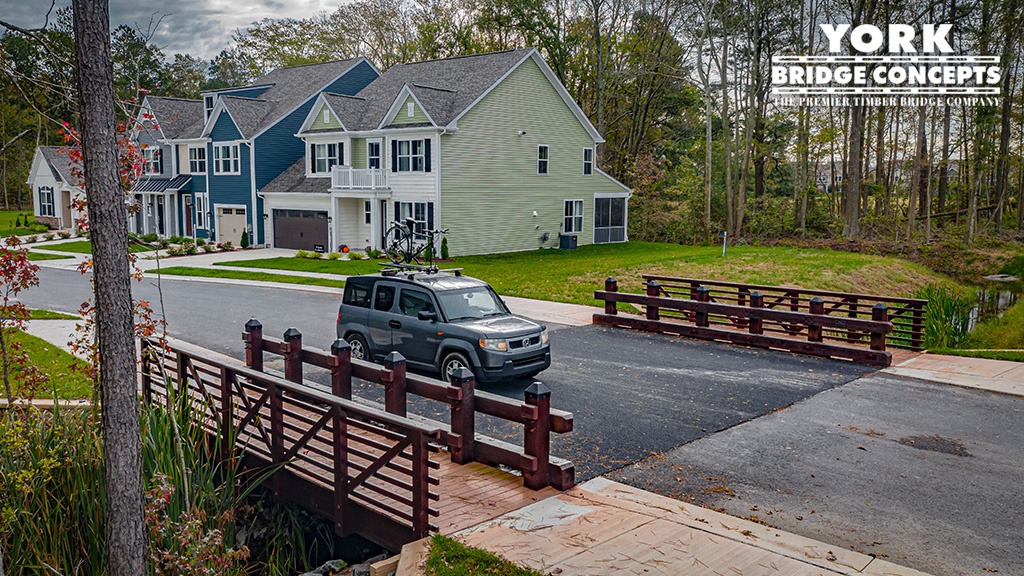
Not every bridge project requires a massive structure spanning hundreds of feet.
In fact, some of the most impactful infrastructure projects involve relatively short crossings that solve access challenges, improve connectivity, protect sensitive environments, and enhance the overall user experience. Short span bridges are often the most practical and cost-effective solution for crossing streams, drainage channels, wetlands, ravines, golf course hazards, retention ponds, and small waterways. Short-span bridge systems are widely utilized because they provide efficient structural solutions while minimizing construction complexity.
At York Bridge Concepts, short span bridge design is about much more than crossing a small obstacle. It is about creating infrastructure that blends into the landscape, improves accessibility, supports sustainability goals, and delivers long-term value.
Through our Design-Engineer-Build™ methodology, we create custom short span timber bridges that combine architectural beauty, engineering performance, and environmental stewardship for communities, parks, resorts, golf courses, campuses, municipalities, and private developments. With more than 9,000 bridges built worldwide, YBC has extensive experience delivering custom bridge solutions across virtually every application.
A short span bridge is generally defined as a bridge that crosses a relatively small obstacle without requiring extensive long-span structural systems.
These bridges are commonly used to cross:
While the exact length varies depending on project requirements, short span bridges are typically selected when site conditions allow efficient crossings with minimal structural complexity.
The key advantage is simplicity: a well-designed short span bridge often provides maximum functionality with minimal environmental and financial impact.
Because these bridges are often smaller than major transportation structures, they are sometimes overlooked during project planning.
However, short span bridges frequently deliver outsized value by:
A strategically placed bridge can transform how people move through a property, park, community, or recreational destination.
Master-planned communities frequently utilize short span bridges to connect:
These crossings improve connectivity while enhancing community character.
Short span bridges are often critical components of trail systems.
They provide safe crossings over:
while maintaining uninterrupted access throughout the park.
Golf cart bridges and pathway crossings often fall within the short-span category.
These structures improve circulation while enhancing the visual appeal of the course itself.
Resorts frequently use short span bridges to connect:
creating memorable guest experiences while preserving natural landscapes.
Private estates often require short span bridges to cross:
while creating distinctive and elegant entrances.
Timber continues to be one of the most effective materials for short span bridge applications.
Its advantages include:
Timber can be adapted to a wide variety of site conditions, architectural styles, and project goals.
Wood blends naturally into parks, communities, waterfronts, golf courses, and wooded environments.
Responsibly sourced timber stores carbon and offers a lower embodied carbon footprint compared to many conventional construction materials. YBC emphasizes timber’s environmental benefits and sustainable sourcing throughout its bridge collections.
Timber bridge systems can often be installed with less disruption to the surrounding environment.
Modern engineered timber systems provide exceptional durability when properly designed, constructed, and maintained.
Many short span bridge projects occur in environmentally sensitive locations.
Examples include:
Successful bridge design must account for both user needs and environmental stewardship.
York Bridge Concepts approaches every project with a commitment to minimizing impacts while maximizing long-term value.
One of the greatest advantages of partnering with York Bridge Concepts is our proprietary Deck-Level Construction™ methodology.
Unlike conventional construction methods that often require extensive access beneath the bridge, Deck-Level Construction™ allows construction activities to progress from the bridge deck itself.
Benefits include:
This methodology is particularly effective for short span bridges located within environmentally sensitive areas.
Pedestrian bridges are among the most common short-span applications.
These bridges help connect:
while creating safer and more enjoyable experiences for users.
YBC’s Walker Collection was developed specifically for pedestrian infrastructure that enhances connectivity and outdoor experiences.
Short span vehicular bridges support:
These structures are frequently used within:
YBC’s Avenue Collection accommodates a wide range of vehicular loading requirements, including emergency vehicle access and HS20-44 applications when required.
Short span bridges offer unique opportunities for placemaking and design.
Popular architectural options include:
Because these bridges are often highly visible and frequently used, they can become defining features within a community or development.
Today’s developers, municipalities, and property owners increasingly seek infrastructure that contributes to broader sustainability goals.
Short span timber bridges support these objectives through:
These benefits make timber bridge solutions particularly attractive for environmentally conscious developments.
Every short span bridge begins with understanding the unique characteristics of the site.
York Bridge Concepts’ integrated Design-Engineer-Build™ process combines:
This approach helps streamline project delivery while ensuring every bridge meets the functional, environmental, and aesthetic goals of the project.
For more than four decades, York Bridge Concepts has specialized in creating custom bridge solutions that combine performance, sustainability, and beauty.
Clients choose YBC because of our:
From small creek crossings to signature community features, every bridge is designed to create lasting value.
A short span bridge may not be the largest structure on a project site, but it can have an enormous impact.
It can connect neighborhoods.
Improve accessibility.
Protect sensitive environments.
Enhance property values.
And create memorable experiences for generations.
Whether your project involves a trail crossing, community connector, golf course bridge, residential access route, park improvement, or environmentally sensitive site, York Bridge Concepts can create a custom short span bridge solution tailored to your vision.
This website uses cookies
We use cookies to personalise content and ads, to provide social media features and to analyse our traffic. We also share information about your use of our site with our social media, advertising and analytics partners who may combine it with other information that you’ve provided to them or that they’ve collected from your use of their services.
Cookies are small text files that can be used by websites to make a user's experience more efficient.
The law states that we can store cookies on your device if they are strictly necessary for the operation of this site. For all other types of cookies we need your permission. This means that cookies which are categorized as necessary, are processed based on GDPR Art. 6 (1) (f). All other cookies, meaning those from the categories preferences and marketing, are processed based on GDPR Art. 6 (1) (a) GDPR.
This site uses different types of cookies. Some cookies are placed by third party services that appear on our pages.
You can at any time change or withdraw your consent from the Cookie Declaration on our website.
Learn more about who we are, how you can contact us and how we process personal data in our Privacy Policy.
Please state your consent ID and date when you contact us regarding your consent.